Guide
Speech games for 5-year-olds that actually get the practice done
Five is a good age for speech games and a bad age for speech drills. A five-year-old can copy a sound, hold a rule in their head, and compete, which means a game can produce fifty correct repetitions in ten minutes. A card deck cannot, because they will be under the table by card six. These ten games are the ones therapists reach for with this age group, ordered by repetitions per minute, followed by the sounds a five-year-old should be working on and the two apps worth using when you want the attempts counted.
The short answer
The best speech games for a five-year-old are simple physical games with a sound attached: feed the monster, knock the tower down, hide and seek with cards, and any board game where every turn costs five words. The sounds most five-year-olds are still working on are S, L, SH, CH, and the beginnings of R and TH. If you want the attempts scored and tracked, Help Me Talk (our app) turns the words into a scrolling adventure at $49.99 a year.
US prices for iOS and Android. Prices vary by country; your store shows the price before you subscribe. The new prices are active on Google Play and take effect on the App Store on October 8, 2026.
Why games, and why five is the right age
Speech change comes from repetitions: the number of times a child produces the target sound correctly, in a word, on purpose. Therapists talk in hundreds per session. A parent with a five-year-old and a set of flashcards gets maybe fifteen before the negotiation starts. The same child inside a game will do sixty and ask for more, which is the whole argument for games and the only reason this page exists.
Five is also the age the late sounds start to arrive. S, L, SH and CH are due between four and six, R and TH between five and eight. So a five-year-old with a lisp or a “wabbit” is on schedule, and the goal of practice at this age is to keep the sound moving rather than to fix it by Friday. That is another reason to keep it light.
Ten games, ranked by repetitions per minute
- 1Feed the monster. A shoebox with a mouth cut in it, and a pile of picture cards for the target sound. Say the word, feed it to the monster. Twenty cards, twenty repetitions, ninety seconds. Let them draw the monster first and it becomes a project they own.
- 2Knock the tower down. Build a tower of blocks. Each word said correctly earns a block to add; when it reaches ten, they get to knock it down. The knock-down is the reward and it costs ten repetitions every time.
- 3Hide and seek with cards. Hide five to ten picture cards around one room. Every card they find has to be said three times before it goes in the pile. Doubles as ten minutes of running around.
- 4Board-game toll. Any board game you already own. Rule: five target words before every roll. A game of Snakes and Ladders is around fifteen turns per player, so seventy-five repetitions without a single flashcard being shown.
- 5I spy with the sound. “I spy something starting with sss.” They find it and say it, then they set the next one for you. Works in the car, at the shops, in the bath, and costs nothing.
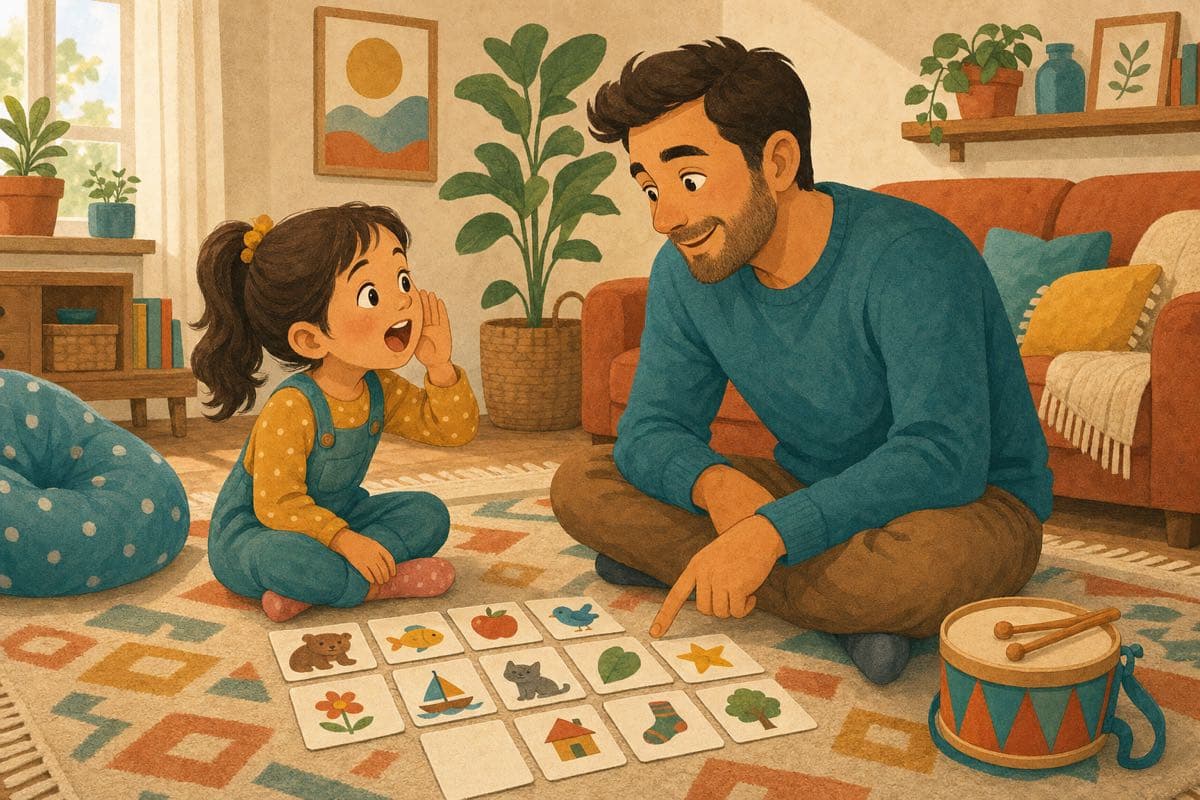
- 6Memory pairs. A matching game made from two sets of the same picture cards. Every card turned over gets said aloud. A twelve-pair game is roughly forty repetitions and they will demand a rematch.
- 7Simon says, with a catch. Simon's instructions all contain the target sound: “Simon says touch your sock,” “Simon says sit on the sofa.” Then swap roles so they give the instructions and produce the words.
- 8Silly sentences. Take three target words and build the most ridiculous sentence you can: “The snake sat on a sandwich.” They repeat it, then try to top it. Good for moving a sound from single words into sentences, which is the step that usually stalls.
- 9Hopscotch words. Chalk a hopscotch grid outside and put a target word in each square. They say the word for every square they land on. Outdoor, loud, and the repetitions add up quickly.
- 10Story in a bag. Put six small objects with the target sound in a bag (for S: a sock, a spoon, a small toy snake). They pull them out one at a time and make up a story that uses all six. Fewer repetitions per minute than the others, which is why it is last, but it is the best game here for carrying a sound into real talking.
Which sounds a five-year-old should be practising
| At five | Sounds | What to do |
|---|---|---|
| Should already be in | p, b, m, h, w, d, n, t, k, g, f, y, ng | If one of these is still wrong at five, that is the one to practise first and the one to mention to a doctor. They are the easiest to fix. |
| Due now (four to six) | s, z, l, sh, ch, j, v | Fair game for daily practice. A lisp at five is the classic case. Pick one sound, not the set. |
| Just starting (five to eight) | r, th | Practise gently if your child is interested; do not force it. R at five is early. R at seven is worth proper help. |
Apps that turn the practice into a game
The kitchen-table games above out-perform most apps at five. Where an app earns its place is counting and scoring: a five-year-old cannot tell whether that S was good, and after twenty of them neither can a tired parent.
Help Me Talk (our app) has a scrolling adventure your child talks their way through: a word appears, they say it, the app listens and scores the attempt, and a good one moves the character forward. Every step is a scored repetition logged against that sound, so at the end of the week you can see whether S is actually improving. Thirty sounds, over 6,000 words, phrases and sentences, on iPhone, iPad and Android at $9.99 a month or $49.99 a year with a 3-day trial. The honest limits: scoring needs a connection, it is English only, and it is still one small developer's app with a few dozen US ratings.
Articulation Station Hive is the app most clinics use and it has matching and flashcard games with a good sound-by-sound structure. The adult judges every attempt rather than the app, it is Apple-only, and the parent plan is about $83.99 a year. Speech Blubs is the biggest name in speech apps but it is built around toddlers copying video clips of other children, which a five-year-old working on one sound outgrows fast.
Best speech therapy games for kids compares the app games in more detail across all ages.
How to run a five-minute session
- 1Pick one sound from the table above. One.
- 2Warm up with five easy words where the sound is at the start (“sun”, “sock”, “soap”).
- 3Play one game from the list for four minutes. Word first, turn second.
- 4End on a good one. Stop while they are still winning, not when they are done. Tomorrow's session depends on it.
- 5Note the wins. Three words they got right today go on the fridge. Next week you will be surprised how many are there.
Practice these sounds
Free word lists, mouth-position guides and games. No app needed.
Help Me Talk is a practice app, not a diagnosis or a replacement for a licensed speech-language pathologist. If you are worried about your child’s speech, talk to your doctor or an SLP. This app is for the practice in between.
Questions parents ask
- What are the best speech games for a 5-year-old?
- Simple physical games with a target sound attached: feeding picture cards to a shoebox monster, knocking down a tower earned one word at a time, hide and seek with cards, and any board game where each roll costs five words. They produce the most correct repetitions per minute, which is what changes a sound. Apps such as Help Me Talk add scoring and tracking on top.
- Which speech sounds should a 5-year-old be working on?
- Usually s, z, l, sh, ch, j or v, which are due between four and six. R and th are just beginning at five and are not expected until five to eight. Any earlier sound still wrong at five (k, g, f, t, d, or leaving sounds off the ends of words) should be practised first and mentioned to a doctor.
- How long should speech practice be for a 5-year-old?
- Five minutes a day beats thirty minutes on Sunday. Inside a game, five minutes is forty to sixty repetitions of the target sound, which is roughly what a therapy session aims for. Stop while your child is still enjoying it so tomorrow's session happens.
- Do speech therapy games for 5-year-olds work without a therapist?
- For keeping a sound moving between sessions, yes; that repetition is the part a parent can genuinely do. For deciding which sound to target and whether there is a wider problem, no. If your five-year-old is hard for strangers to understand or has several sounds wrong, an assessment comes first and the games run alongside it.
- Are there free speech games for kids?
- Every game on this page is free and runs on picture cards you can make from the word lists on the sound pages here, which are also free. Each sound page adds three games written for that sound. The paid part of speech apps is the scoring and record-keeping, not the games themselves.
- What speech app is best for a 5-year-old?
- Help Me Talk if you want each attempt scored and the sound tracked over weeks, at $49.99 a year on iPhone, iPad and Android. Articulation Station Hive if you are working with a therapist who uses it and you are on Apple devices. Speech Blubs is better suited to toddlers building first words than to a five-year-old working on a specific sound.
Keep reading
- Best speech therapy games for kids
- Speech therapy exercises for kids
- Speech therapy at home: a weekly plan
- The 4-year-old speech checklist
- How to fix a lisp in a child
- The 5-year-old speech checklist
- The 18-month speech checklist
- The 2-year-old speech checklist for your child
Last updated 7 October 2026.