Checklist
The 2-year-old speech checklist for your child
Two is the age the questions start. Relatives compare, the nursery mentions it, and every article quotes a different word count. This is the list the CDC actually publishes for age two, the one it publishes six months later at 30 months (which is where the word count now lives), the sounds a two-year-old is and is not expected to have, and the handful of signs that mean you book the appointment rather than wait for three.
The short answer
The CDC's checklist for two says a typical child says at least two words together (“More milk”), points to things in a book when you ask, points to at least two body parts, and uses gestures beyond waving and pointing, like blowing a kiss or nodding yes. The famous “50 words” milestone moved to 30 months in the CDC's 2022 revision. At two, speech is often unclear to strangers and that is normal. Not combining words, having lost words, or not pointing at all are the signs to act on now.
The talking checklist at two: four things to tick off
These are the language and communication milestones the CDC lists for age two, checked on 6 September 2026. Since the 2022 revision the CDC's checklists describe what 75% or more of children can do by that age, so a tick means your child is doing what most children do, and a miss means they are in the last quarter, which is a prompt rather than a verdict.
Think about the last week, not the best day.
- Says at least two words together, like “More milk.” Two real words, joined on purpose. “All gone”, “Daddy car”, “No bath” all count. A single long word does not, and neither does a phrase copied whole from a song.
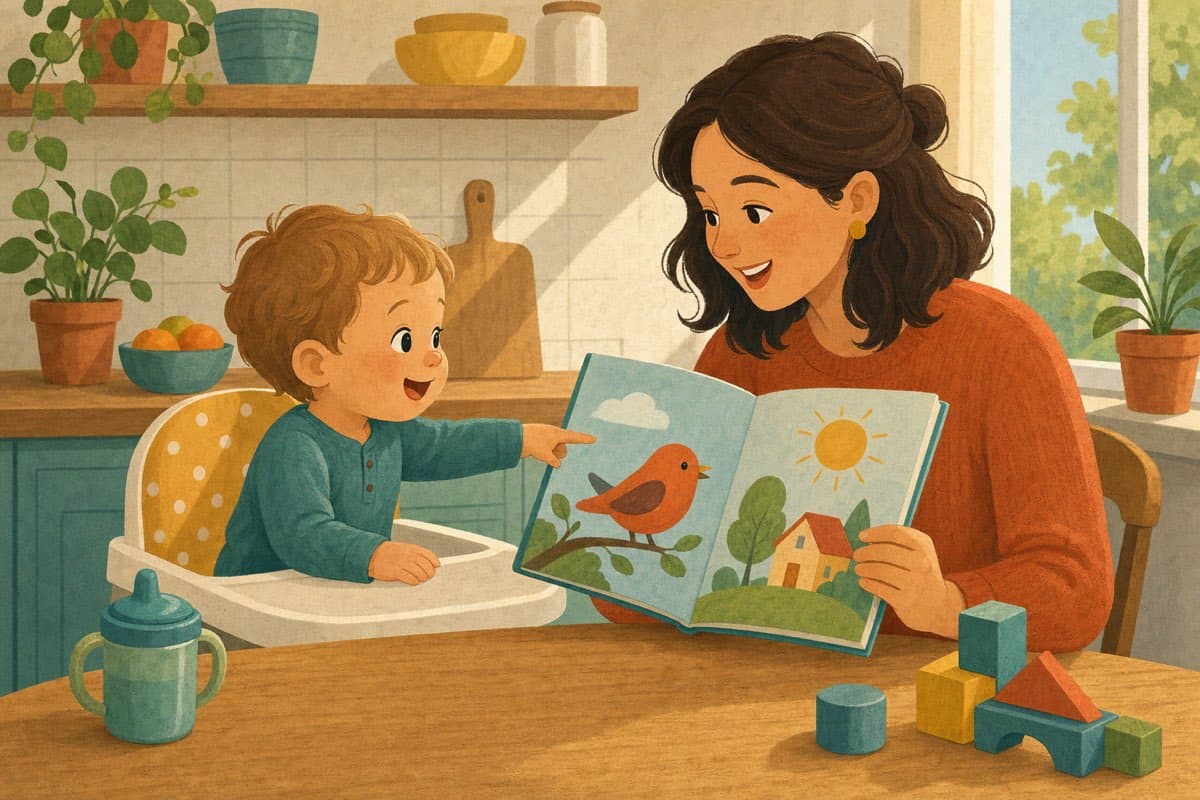
- Points to things in a book when you ask, like “Where is the bear?” This is understanding, and it matters as much as talking. A child who points to the right picture but says little is in a different situation from a child who does neither.
- Points to at least two body parts when you ask. Nose and tummy will do. Again, it is comprehension being checked, not speech.
- Uses more gestures than just waving and pointing. Blowing a kiss, nodding yes, shrugging, a finger to the lips for “shh”. Gesture is the scaffolding words get built on, and a child with a rich set of gestures usually has the words coming.
The next list is only six months away: 30 months
The CDC's 30-month checklist is where the numbers live, and it is worth reading at two so you know what is coming. By two and a half a typical child:
- Says about 50 words. Any words count, including the child's own versions (“baba” for bottle), as long as they mean the same thing every time.
- Says two or more words together, with one action word, like “Doggie run.” This is the step up from “more milk”: a doing-word in the mix.
- Names things in a book when you point and ask, “What is this?” At two they pointed to your word. At 30 months they supply the word.
- Says words like “I”, “me” or “we.” Pronouns are a small thing that shows a big shift, from labelling to talking about themselves.
Sounds at two: what should be there, and what should not
Parents worry about clarity at two more than anything else, and most of that worry is misplaced. ASHA's milestones for two to three say speech in this window “may not be understandable to unfamiliar listeners.” That is the expected state, not a problem.
| At two | Sounds | What it looks like at home |
|---|---|---|
| Arriving now, solid by three | p, b, m, h, w, d, n and most vowels | “Mama”, “bye-bye”, “no”, “hi”. If these early sounds are missing entirely at two and a half, mention it. |
| Not due until three to four | t, k, g, f, y, ng | “Tat” for “cat” and “doe” for “go” are normal at two. |
| Not due until four to eight | s, l, sh, ch, j, v, z, r, th | Nobody should be working on R or S with a two-year-old. Let it go. |
The signs that mean act now, not at three
The CDC's own advice is “don't wait,” and at two there are specific reasons not to. Book an appointment with your doctor, and ask about a developmental screening and a hearing test, if your child:
- Is not putting two words together by two, or has fewer than about 20 words with no sign of new ones arriving.
- Has lost words or skills they had. Regression at any age is the sign the CDC flags most strongly.
- Does not point, wave, or use gestures to show you things. Late talking with strong gestures usually resolves. Late talking without gestures is a different picture.
- Does not respond to their name or to simple instructions without a gesture from you. Rule out hearing first; glue ear after a run of colds is common at this age and fixable.
- Does not point to pictures or body parts when asked, which suggests understanding is behind as well as talking.
- Is frustrated to the point of tantrums about not being understood, which tells you the gap between what they want to say and what they can say is already wide.
What helps at two
At this age the work is language, not pronunciation. The CDC's own tip for two-year-olds is to repeat and expand what your child says, so “doggie” becomes “Yes, a big brown doggie.” Narrate what you are doing. Give a choice between two named things (“apple or banana?”) so an answer needs a word. Read the same books over and over and pause before the word your child knows. Turn off background television, which cuts the number of words a child hears in a room by a surprising amount.
Apps have a smaller role at two than at four. Help Me Talk, which we make, is built mostly for children of three and up who can copy a sound on request; the parts that suit a two-year-old are the picture boards, where your child taps pictures to build a short sentence and hears it spoken, and the daily plan the app builds from a short questionnaire so you are not guessing what to do tonight. If your two-year-old has plenty of words but they are hard to understand, the free sound pages show which sounds are due when, so you practise the right ones and ignore the rest.
- Speech milestones by age, one to five: the whole timeline in one place
- Best speech apps for late-talking toddlers: what works before three, honestly
- The 3-year-old checklist: the next list, so you know what is coming
Practice these sounds
Free word lists, mouth-position guides and games. No app needed.
Help Me Talk is a practice app, not a diagnosis or a replacement for a licensed speech-language pathologist. If you are worried about your child’s speech, talk to your doctor or an SLP. This app is for the practice in between.
Questions parents ask
- What should a 2-year-old be able to say?
- The CDC's checklist for two years says most children put at least two words together (“More milk”), point to things in a book when asked, point to at least two body parts, and use gestures beyond waving and pointing, like blowing a kiss or nodding. There is no word-count milestone at two anymore; the CDC's “about 50 words” sits at 30 months since the 2022 revision.
- How many words should a 2-year-old have?
- The CDC no longer sets a word count at 24 months. Its 30-month milestone is about 50 words, describing what 75% of children do. A two-year-old with fewer than about 20 words and no two-word combinations is worth a conversation with a doctor, because the next milestone is only six months away and early help is easier.
- Does the CDC say a 2-year-old should say two words together?
- Yes. The CDC's official 2-year milestone is “Says at least two words together, like ‘More milk.’” It is the first language item on the checklist and the one that matters most at this age, because combining words is the step that predicts sentences.
- What does the CDC say an 18-month-old should say?
- The CDC's 18-month checklist says a child tries to say three or more words besides “mama” or “dada,” and follows one-step directions without any gestures, such as giving you a toy when you say “give me the toy.” If your child is two and still at that level, it is worth an appointment.
- Is it normal for a 2-year-old to not talk clearly?
- Yes. ASHA says speech between two and three “may not be understandable to unfamiliar listeners,” and most sounds are not due until three or later. A parent typically understands about half of what a two-year-old says. Unclear speech is expected; no words, no combinations, or lost words are the things to act on.
- When should I worry about my 2-year-old's speech?
- Act early if your child is not combining two words, has lost words or skills, does not point or gesture, does not respond to their name or simple instructions, or does not point to pictures and body parts when asked. Ask your doctor for a developmental screening and a hearing test. Waiting until three is the advice the CDC specifically tells parents not to follow.
- Can a speech app help a 2-year-old?
- A little, and mostly the picture-based parts. Sound practice needs a child who can copy a sound on request, which is usually three or older. At two, the best help is a parent repeating and expanding words, reading, and giving choices that need a word. Help Me Talk's picture boards and its daily plan suit this age; its 30 sound lessons are for later.
Keep reading
- Is my 2-year-old a late talker?
- Speech milestones by age, one to five
- The 3-year-old speech checklist
- Best speech apps for late-talking toddlers
- Speech delay vs language delay
- The 18-month speech checklist
- The 4-year-old speech checklist for your child
- The 5-year-old speech checklist
Last updated 6 September 2026.