Guide
Speech delay vs language delay in children
These two phrases get used interchangeably by almost everyone except the professionals who treat them, which is a shame, because they mean different things and lead to different help for your child. If you can work out which one you are looking at, everything else gets easier.
The short answer
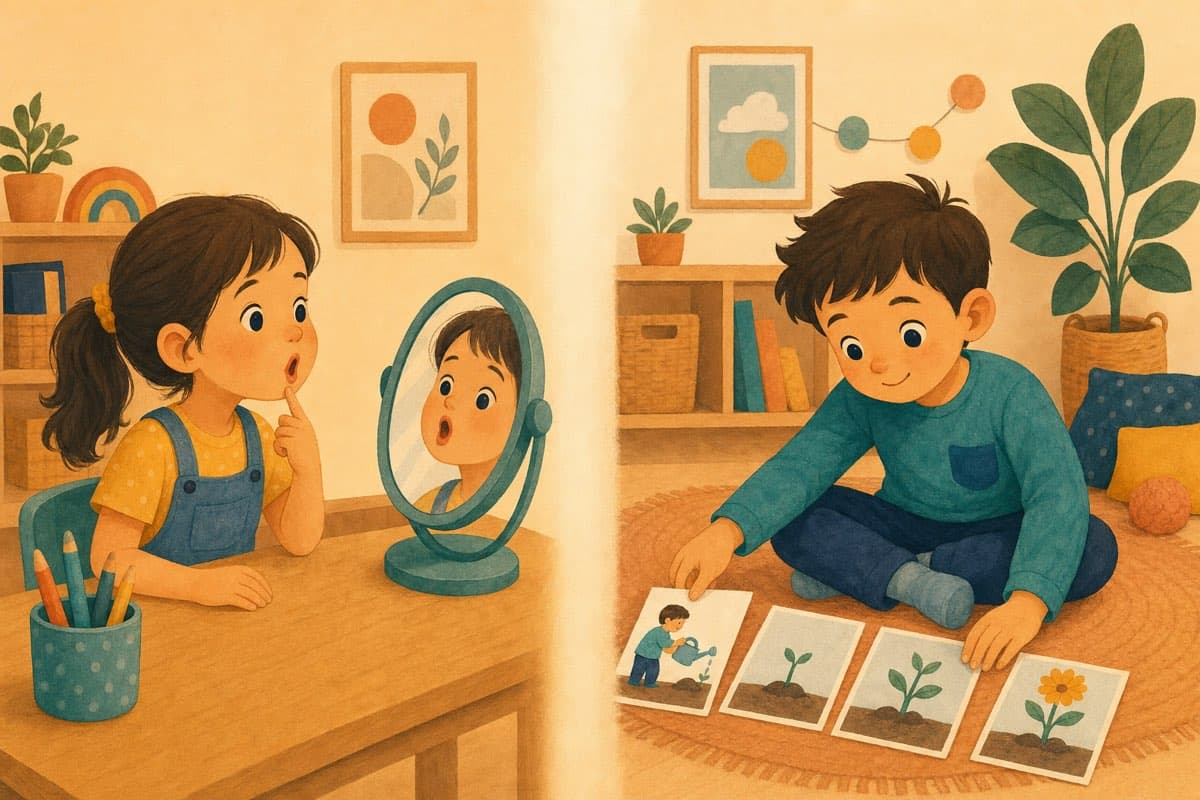
Speech is the physical production: the sounds coming out of the mouth. Language is the system underneath: knowing words, putting them together, and understanding other people. A child with a speech delay has things to say and cannot say them clearly. A child with a language delay has fewer things to say in the first place.
The difference in one table
| Speech delay | Language delay | |
|---|---|---|
| What it is | The sounds are hard to produce clearly | Words, sentences or understanding are behind |
| Sounds like | “tat” for “cat”, “wabbit” for “rabbit”, a lisp | Very few words; no two-word combinations; not following instructions |
| Vocabulary size | Usually normal | Usually small |
| Understanding | Usually fine | Often affected too |
| Typical worry | “Nobody can understand him” | “She hardly says anything” |
| What helps | Sound-by-sound practice | More conversation, modelling, vocabulary building |
What a speech delay looks like
The child has plenty to say. They chat away in full sentences about their day, and a good chunk of it is hard to decode. Grandparents ask you to translate, and strangers smile and nod.
Underneath, this is usually a set of consistent patterns rather than random errors: all the back sounds moving to the front (“tat” for “cat”), all the liquids turning into W (“wabbit”, “wion”), the ends of words dropping off. Once you spot the pattern, practice gets a lot more targeted.
What a language delay looks like
Here the quantity is the issue rather than the clarity. The words that do come out may be perfectly clear. There are just not many of them, or they do not go together, or your child does not seem to follow what you say.
Language splits again into two halves, and professionals will assess them separately: expressive language (what your child can produce) and receptive language (what they understand). A child who understands well but says little has a different profile, and generally a better outlook, than one where both are behind.
- Fewer than about 50 words at two years old
- No two-word combinations by two
- Does not follow a simple instruction without gestures
- Does not point to things you name in a book
- Uses the same few phrases for everything
- Struggles to answer simple questions even when the words are clear
Why it matters which one it is
Because the help is different, and using the wrong help wastes months.
For a speech difficulty, the work is motor practice: one sound at a time, up through words, phrases and sentences, with feedback on each attempt. That is repetitive and it responds well to daily home practice, which is exactly what a practice app is good at.
For a language difficulty, drilling sounds does nothing. The work is more conversation, richer modelling, waiting longer for your child's turn, and building vocabulary through play and books. An app helps here only as something to talk about together, not as a substitute for the talking.
This is the honest reason we do not claim Help Me Talk is the answer for every child. It is built for the speech side. For a two-year-old with very few words, the things that help most are free, and they are in this guide.
Getting it properly sorted out
A speech-language pathologist will assess both, separately, and tell you which is behind and by how much. That single appointment is what turns a vague worry into a plan, and it is the thing most worth paying for if you are paying for anything.
Two things to do before it: get hearing checked, because intermittent hearing loss from repeated ear infections is a common and very fixable contributor to both; and keep a week's list of everything your child actually says, which is far more useful to a clinician than your best recollection on the day.
Practice these sounds
Free word lists, mouth-position guides and games. No app needed.
Help Me Talk is a practice app, not a diagnosis or a replacement for a licensed speech-language pathologist. If you are worried about your child’s speech, talk to your doctor or an SLP. This app is for the practice in between.
Questions parents ask
- What is the difference between speech and language?
- Speech is the physical act of producing sounds. Language is the system of words and rules underneath it: knowing words, combining them, and understanding others. A child can have excellent language and unclear speech, or perfectly clear speech and very little language.
- Which is more serious, a speech delay or a language delay?
- Language delays generally have wider knock-on effects, because language underpins reading, learning and social skills. But severity matters more than category: a severe speech disorder that leaves a child unintelligible at five is a bigger problem than a mild language delay. Both respond better to earlier help.
- Can a child have both?
- Yes, and it is common. They also feed each other. A child who is hard to understand often talks less, which limits language practice. Part of what an assessment does is untangle which one is driving the other.
- Does a speech delay mean autism?
- No. Speech delay on its own is not a sign of autism. What professionals look at alongside it is the wider communication picture: pointing, eye contact, showing you things, shared attention, play. If those are all present and only the speech is behind, that is a very different profile. If several are absent, mention it to your doctor.
- Will my child catch up on their own?
- Many do, particularly with speech sounds that are simply late. Nobody can tell you in advance whether yours will, and the children who do not catch up are the ones early help benefits most. That is why an assessment is worth doing rather than waiting to find out.
Keep reading
- Is my 2-year-old a late talker?
- Speech milestones by age
- The 18-month speech checklist
- The 2-year-old speech checklist for your child
- The 3-year-old speech checklist for your child
- The 4-year-old speech checklist for your child
- The 5-year-old speech checklist
- Apps that listen to your child’s speech and score it
Last updated 25 July 2026.