Guide
Apps that listen to your child’s speech and score it
Most speech apps for children show a picture, play the word and wait. Whether your child actually said it right is left to whoever is sitting next to them. That is fine if you can hear the difference between a good R and a near miss, and much harder if you cannot. A small number of apps listen to your child and score the attempt instead. This page covers what that scoring actually measures and when an app that leaves the judging to you is the better buy for your child.
The short answer
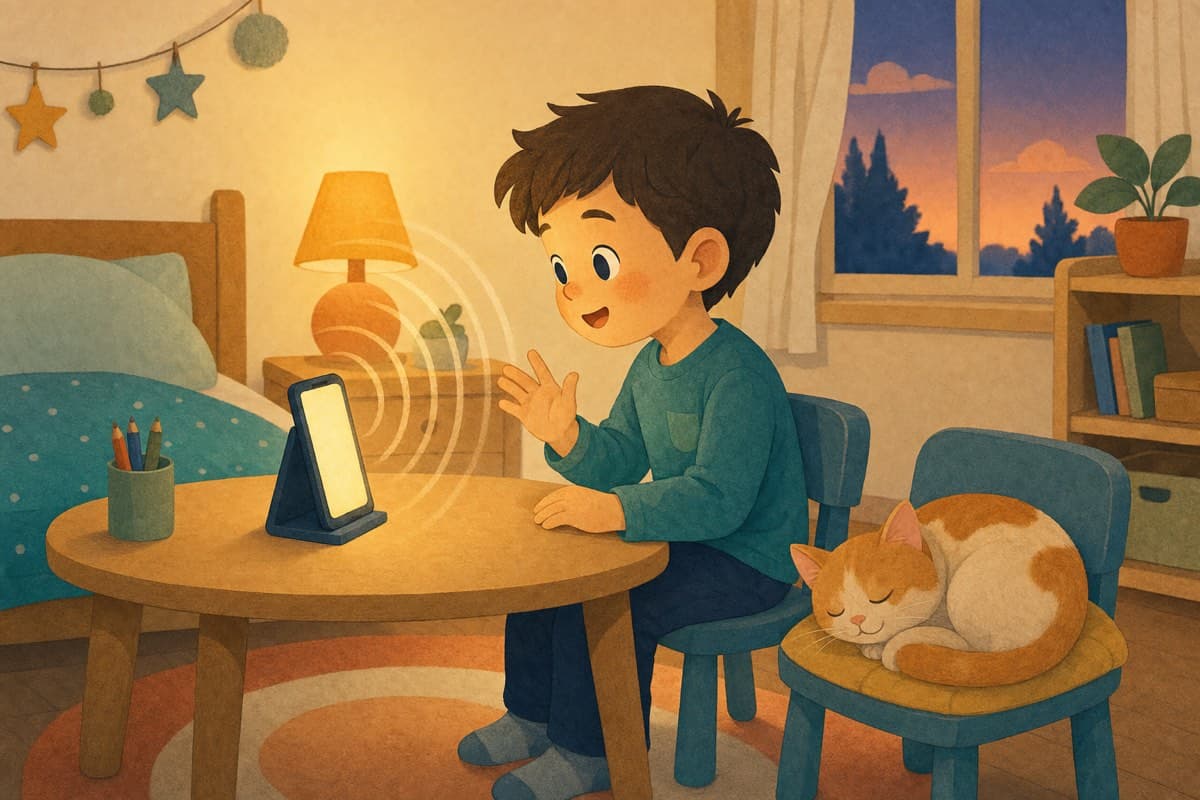
Yes. A few children’s speech apps score pronunciation. Your child says the word out loud and the app returns a number for how close the attempt was. Treat that as practice feedback rather than an assessment. It cannot diagnose anything, the number moves around with background noise, and it needs a child old enough to attempt a sound on request, usually around three. What it does answer is the question a parent cannot answer alone: is “wabbit” slowly turning into “rabbit”, or does it only feel like it?
US prices for iOS and Android. Prices vary by country; your store shows the price before you subscribe. The new prices are active on Google Play and take effect on the App Store on October 8, 2026.
Three different things apps mean by “listening”
The word is used for three quite different mechanisms, and the marketing rarely distinguishes them. Work out which one you are buying before you judge whether it is working.
| What the app does | What it tells you about your child | |
|---|---|---|
| Voice-activated | Any noise above a threshold moves the activity on | Nothing about the sound they made. A cough advances the card |
| Speech recognition | Matches what it heard against the target word | Whether the word was recognisable, not how close the sound was |
| Pronunciation scoring | Measures the attempt against the expected pronunciation and returns a number | How close the attempt was, and which sound inside the word let it down |
What a score can tell you, and what it cannot
Automated pronunciation feedback is genuinely useful for one narrow job: keeping count of something you cannot keep counting yourself, thirty times an evening, honestly. It is not a clinical measure and no app should sell it as one.
- It can count when you cannot. Twenty attempts in five minutes is more judgements than any parent makes reliably, especially on a sound you are not sure you can hear.
- It can show a trend over weeks. One score means very little. Forty scores on the same sound across a month is a line you can actually read, and it is the reason to bother.
- It cannot diagnose anything. A score is not a screener and not a referral. If something worries you, that is a conversation with your doctor or a speech-language pathologist, whatever the app says.
- It cannot replace an ear for the errors that need a professional. A lateral lisp, the wet slushy S, is the standard example. Fixing it means hearing where the air is going, and that takes an appointment rather than an app.
- It is one take, in one room, on one microphone. Background noise and how far the phone sits from your child both move the number. Treat the trend over weeks as the signal and any single score as noise.
- It cannot make a child practise. The scoring is the easy part to automate. Getting five willing minutes out of a four-year-old is still your job.
Which children’s speech apps actually score the attempt
Most apps in this category leave that judgement to the adult. Only a couple of the mainstream children’s apps run speech recognition against the target word and give the child a verdict of their own.
In practice that means two: ours and Otsimo. If scoring is the feature you are shopping for, those are the two to put side by side, and we have written that out properly as an Otsimo comparison, including the lifetime purchase, which is the one thing Otsimo offers that we do not.
| App | Does it score speech? | Platforms | Who it fits |
|---|---|---|---|
| Help Me Talk | Yes. A score per attempt, tracked per sound | iPhone, iPad, Android | A parent running daily practice who is not sure what a correct sound sounds like |
| Otsimo | Yes. Speech recognition checks the attempt | iOS, Android | Families who would rather buy once than subscribe |
| Speech Blubs | No. Voice-activated only, with no score | iOS, Android | A toddler copying video clips to build first words |
| Articulation Station Hive | No. The adult judges every attempt | iPhone, iPad, Mac | Speech-language pathologists, and parents working closely with one |
How the scoring works in Help Me Talk
Your child sees a word with a picture and says it out loud. The app records that one attempt, sends it over an encrypted connection to our own server, which passes it to a specialist speech-analysis service, and only the results come back: how accurate the sound was, an overall pronunciation figure and the words that were recognised. We do not keep the audio; it exists in memory for the length of that one request. The app privacy policy spells all of that out.
What your child sees is a verdict and stars. What you see, on the same card, is the sound accuracy score, the overall pronunciation figure and the number the attempt had to beat to pass, so a “try again” next to a high-looking number is never a mystery. That pass mark is not fixed: the short set-up questionnaire asks how much difficulty your child has, and a child described as having severe difficulty is not marked wrong for an attempt that is real progress for them.
The part that matters over months is smaller than the headline number. The service returns a score for each sound inside the word, so the app pulls out the score for the sound you are actually working on (the R in “rabbit” rather than the whole word), and it is that figure the per-sound progress is built from, week by week.
The honest limits, in one place: the app covers English only; it has 4.2 stars from 36 US App Store ratings, because it is one independent developer rather than a funded company; and the detailed score needs a connection, because the scoring runs on a server rather than on the phone.
- Strong: the app does the judging, 30 sound lessons, over 6,000 practice words, phrases and sentences, and it runs on Android as well as iPhone and iPad
- Weak: English only, a small rating base, and no score without a connection. See what still works offline
- Costs: free to download with a 3-day trial that unlocks everything, then $9.99 a month or $49.99 a year on the US App Store. There is no permanently free tier
When the app that leaves the judging to you is the better buy
Scoring solves a problem some families do not have. If you can already hear the difference between a correct S and a near miss, either because you have been shown or because you work with a therapist who checks in, then you are a better judge than any microphone, and you should buy for content and structure instead.
In that case Articulation Station Hive from Little Bee Speech is the stronger tool, and it is the one most likely to be on the iPad in a speech clinic. It does not score speech at all; it gives you the fullest level structure in the category and proper record-keeping, and the adult supplies the verdict. It is Apple-only (iPhone, iPad and Mac), and the parent plan runs about $84 a year with a 14-day trial (App Store listing, checked August 2026).
Age matters too. Pronunciation scoring needs a child who can attempt a sound on request, which usually arrives around three. For a two-year-old with a handful of words, a scoring app will sit unused for a year, and something like Speech Blubs, where your child copies video clips of other children saying words, is the better fit for where they actually are. Our Speech Blubs comparison sets out where that stops being true, which is roughly the point your child can attempt a sound on request.
And if your child’s S sounds wet and slushy rather than like a TH, no app is the answer this month. That is a lateral lisp, and it is one of the few speech errors that reliably needs a person.
How to use a score without letting it run your evenings
- 1Pick one sound and stay on it. Two sounds at once halves the practice each one gets and makes the trend unreadable.
- 2Practise in the same room, at the same distance, at the same time of day. Consistency is what makes week-to-week numbers comparable. A noisy kitchen on Tuesday is why Tuesday looks bad.
- 3Read the week rather than the take. Look at the trend once a week. Looking after every attempt teaches you nothing and teaches your child that a number is watching them.
- 4Do not read the number out loud. Your child gets stars and a “try again”; that is enough feedback for them. The score is a parent’s instrument.
- 5Stop while they are still enjoying it. Five minutes. The session that runs two minutes long is why tomorrow’s is a fight.
- 6Recount by hand once a month. Ask for the same ten words and count how many sound right to you. If your count and the app’s trend disagree badly, trust your ears and get an opinion.
Practice these sounds
Free word lists, mouth-position guides and games. No app needed.
Help Me Talk is a practice app, not a diagnosis or a replacement for a licensed speech-language pathologist. If you are worried about your child’s speech, talk to your doctor or an SLP. This app is for the practice in between.
Questions parents ask
- Can an app tell if my child is saying a sound correctly?
- Some can. Help Me Talk and Otsimo both use speech recognition to check the attempt and return a score, while most children’s speech apps display the word and leave the judgement to the adult sitting next to the child. A score is practice feedback rather than an assessment, so read the trend over weeks rather than any single number.
- Is there a speech app that listens to my child and scores pronunciation?
- Yes. Help Me Talk asks your child to say each word out loud, scores how close the pronunciation was, and tracks that sound’s scores week by week on iPhone, iPad and Android. It is a practice app, not a diagnosis, and the detailed score needs an internet connection because the scoring runs on a server.
- How accurate are automated pronunciation scores for children?
- Accurate enough to show a trend, not accurate enough to settle a question about your child’s development. Background noise, microphone distance and a child mumbling all move the number, which is why forty scores across a month tell you something and one score tells you almost nothing.
- What age does a child need to be for a speech app that scores?
- Roughly three and up, because pronunciation scoring needs a child who can attempt a sound on request. Below that, picture-based apps and video-modelling apps such as Speech Blubs suit where a toddler actually is. Help Me Talk also includes picture boards for children who are not ready for words yet.
- Do speech apps record my child’s voice?
- To score an attempt, something has to. In Help Me Talk the recording is held in temporary storage on the device, sent over an encrypted connection for scoring, and not kept afterwards. There is no account to attach it to and nothing is retained. Any app that scores speech should tell you exactly this in plain language before you install it.
- Is an app that scores pronunciation a replacement for a speech therapist?
- No. Help Me Talk does not screen, diagnose or flag anything, and neither does any other app in this category. It is for the practice between appointments, or while you sit on a waiting list. If you are worried about your child’s speech, talk to your doctor or a speech-language pathologist.
Keep reading
- Best apps for dysarthria
- What a speech app can still do for your child offline
- Best articulation apps for kids
- An Articulation Station alternative for parents
- The 18-month speech checklist
- The 2-year-old speech checklist for your child
- The 3-year-old speech checklist for your child
- The 4-year-old speech checklist for your child
Last updated 7 October 2026.