Guide
Vocalic R, and why fixing one R does not fix the rest
A parent is told their child has "an R problem", works on it for six months, and gets a clean R at the start of words. Then "car" is still "cah" and "bird" is still "buhd", and it feels like nothing happened. Nothing went wrong. English has an R at the start of a syllable and a family of R sounds that sit after a vowel, and they are different targets with different tongue shapes. Speech therapists call the second family vocalic R, and it is the reason R takes longer than any other sound in English.
The short answer
Vocalic R is the R that follows a vowel, as in car, bird, hair and ear. Most therapists work with seven types: AR, OR, EAR, AIR, IRE, ER and RL, each with a slightly different tongue position, and a child can master one while still missing the others. It is separate from prevocalic R, the R that starts a syllable in red or rabbit. Prevocalic R usually arrives first and is often used as the way in to the vocalic ones. R as a whole is one of the last English sounds to settle, commonly not until age seven or eight.
The two families of R
The reason they behave differently is physical. In red, the tongue starts in the R shape and moves away from it into the vowel. In car, the tongue starts in a vowel and has to arrive at the R shape, and which vowel it starts from changes the journey. That is why a child can nail red and still miss car: the target is the same shape reached from a different direction.
| Prevocalic R | Vocalic R | |
|---|---|---|
| Where it sits | Before a vowel: red, rabbit, bread | After a vowel: car, bird, hair |
| Also called | Consonantal R, initial R | R-controlled vowel, vowelised R |
| How many targets | One | Seven, treated separately |
| Usually arrives | First | After, often much later |
| What it sounds like when it fails | "Wed" for red | "Cah" for car, "buhd" for bird |
The seven vocalic R types, with the words to practise them
Some clinicians split these differently, and you will see lists of six or eight depending on whether RL is counted and whether ER and IR are treated as one. The number matters less than the principle: work them one at a time, get one stable, then move.
ER is usually the most useful one to start with, because it appears in the ending of hundreds of everyday words: teacher, water, sister, better, over, under. A child who fixes ER alone sounds noticeably clearer to a stranger.
| Type | Sounds like | Practice words |
|---|---|---|
| AR | "ar" as in car | car, star, farm, park, shark, barn, arm, hard |
| OR | "or" as in for | door, four, corn, fork, horse, store, more, north |
| EAR | "eer" as in deer | ear, deer, near, beard, cheer, year, clear, hear |
| AIR | "air" as in chair | air, chair, bear, hair, care, share, stairs, where |
| IRE | "ire" as in fire | fire, tire, wire, hire, choir, empire |
| ER | "er" as in bird | bird, girl, her, water, teacher, dinner, purple, first |
| RL | R and L together | girl, curl, world, pearl, squirrel, whirl |
When should vocalic R be there?
R is the classic late sound. The developmental norms most therapists use put consonantal R somewhere around six to seven, with vocalic R often trailing to eight or beyond. A five-year-old saying "wabbit" is inside the normal range. A seven-year-old still saying "cah" for car is worth an appointment.
Two things move that judgement earlier. If the child is being teased or has stopped saying words with R in them, the social cost has already arrived and waiting is not neutral. And if R is one of several sounds missing rather than the only one, the pattern points at something broader than a single late sound.
How to practise it at home
Our R sound page has the full word, phrase and sentence lists plus audio for every one, free and with no app needed. Help Me Talk, which we make, is the same lists with a score out of 100 on each attempt, which is the part that is hard to do at home by ear.
- 1Pick one type and stay there. ER is the usual first choice for the number of words it unlocks. Do not mix AR and OR in the same session.
- 2Start at the end of a word, not the start. "Ah... er" said slowly is easier than "water" said at speed. Build the syllable, then attach it.
- 3Use a word your child already gets right as the springboard. If prevocalic R is clean, say "red" and then hold the R shape and slide backwards into "ar". Therapists lean on this constantly.
- 4Let them hear themselves. Children hear their own R as correct until something plays it back. A recording, or an app that scores the attempt, breaks that faster than being told.
- 5Five minutes, most days. Repetition count is what moves R, and a long weekend session loses to short daily ones.
Inside the app
See a practice session, step by step
This is the R sound in Help Me Talk. Your child says the word, the app scores the attempt and asks for another try when the sound slips.
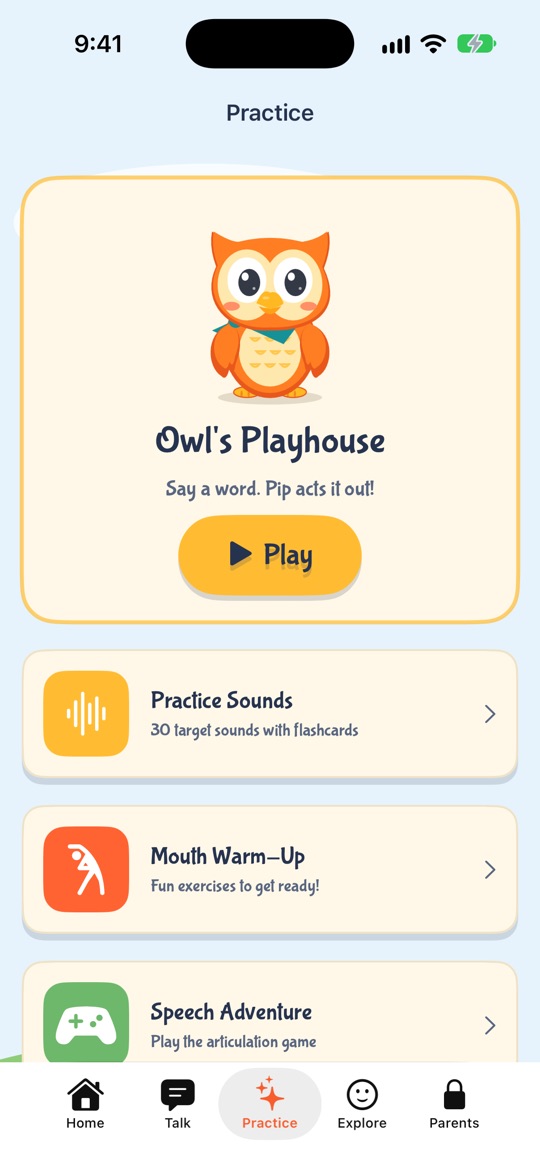
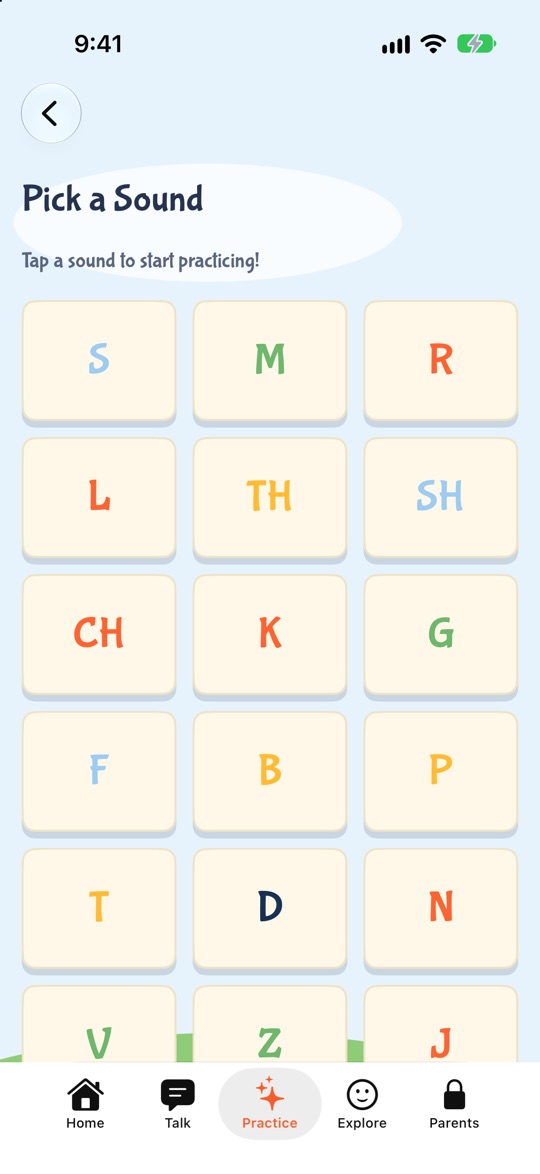
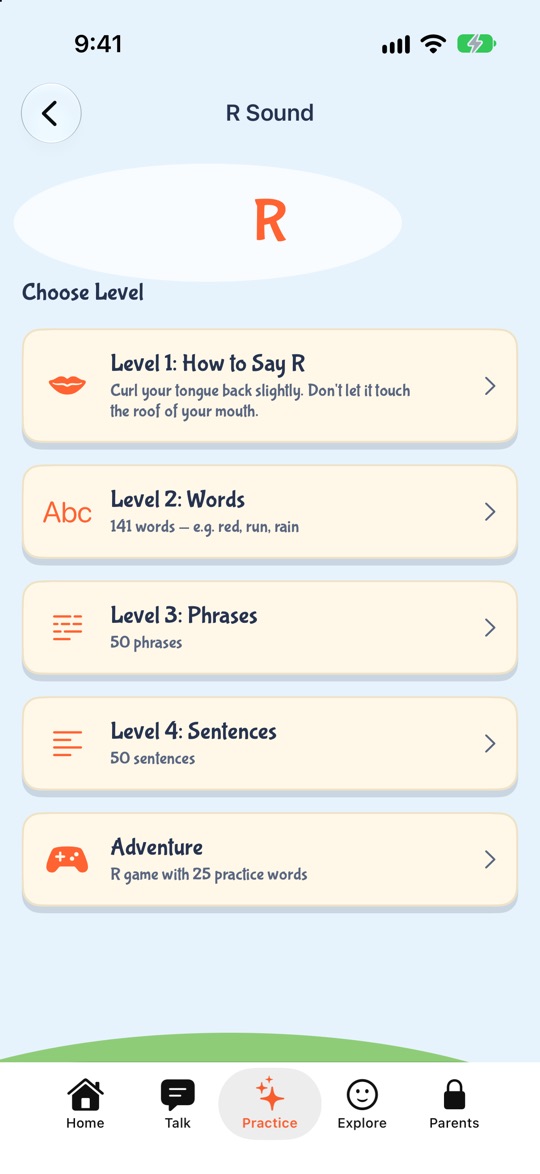
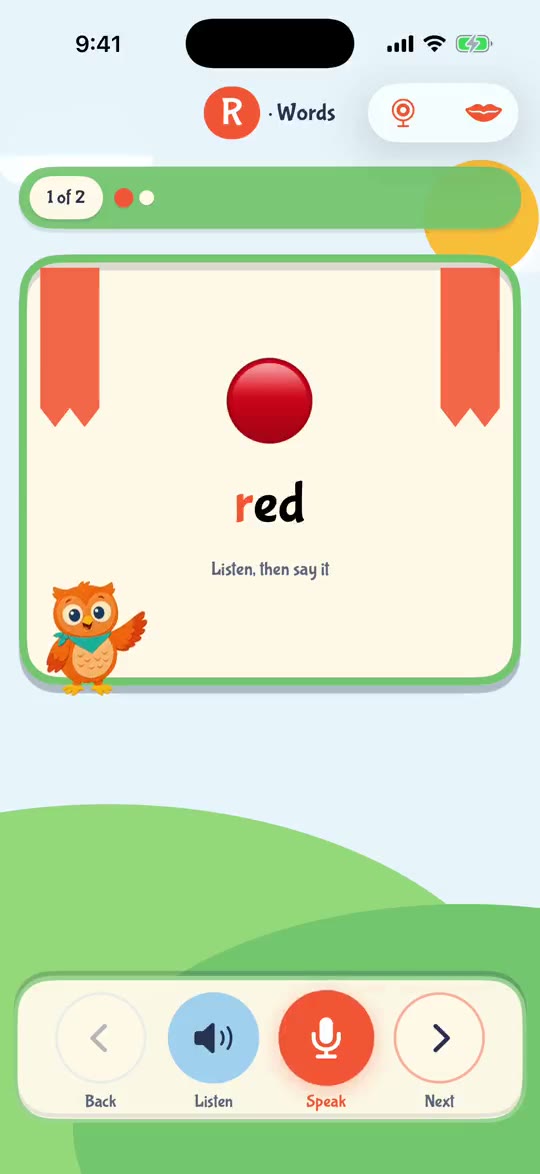
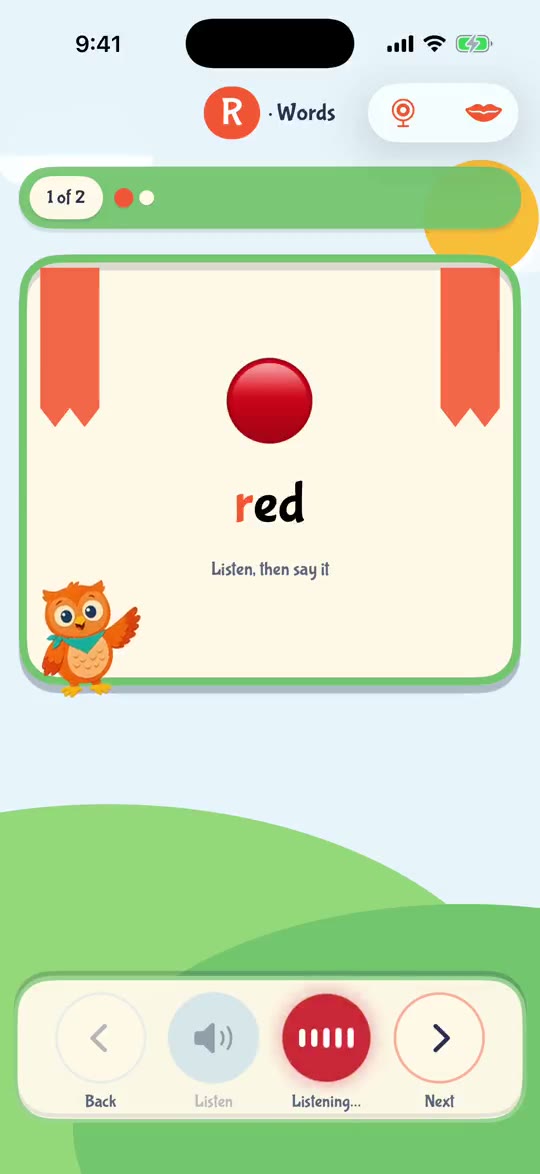
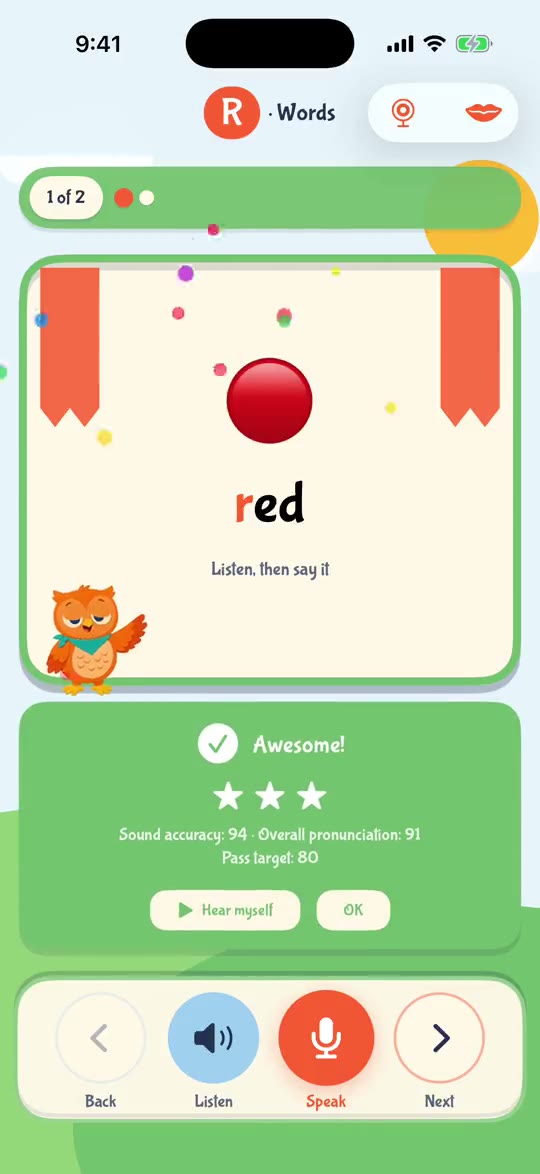
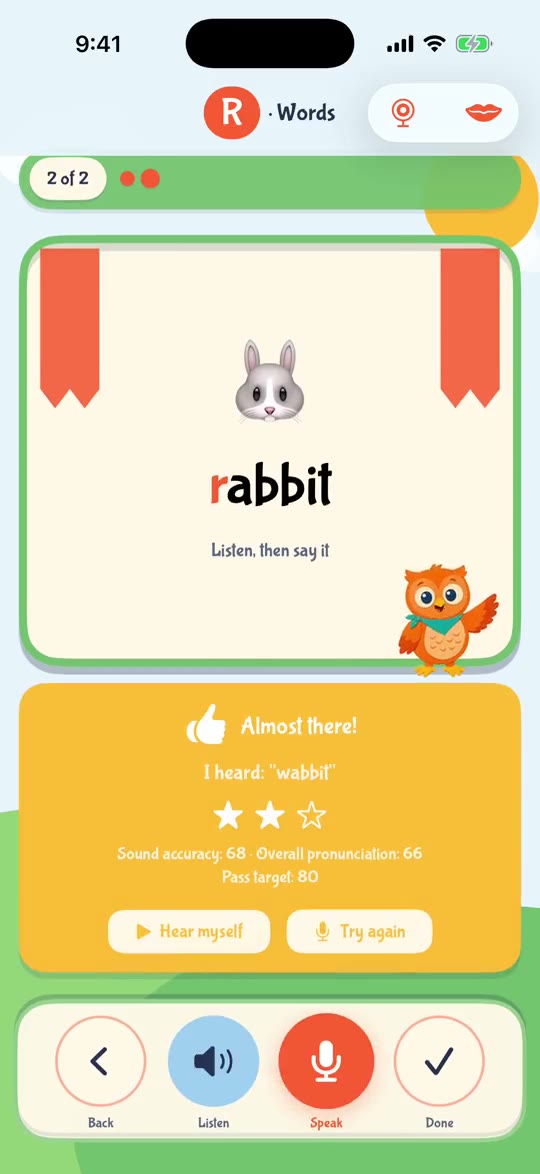
1. Open Practice Sounds
30 target sounds, each with words, phrases and sentences.
Try it with your child. Free to download.
What about vocalic L?
The same idea applies to L, though it causes less trouble. Vocalic L is the L at the end of a syllable in ball, apple, table and pencil, where the tongue tip may not touch at all. Children who say "baw" for ball are producing a vocalic L that has not fully arrived, and it usually resolves a year or two before R does. Our L sound page carries the word lists.
Practice these sounds
Free word lists, mouth-position guides and games. No app needed.
Help Me Talk is a practice app, not a diagnosis or a replacement for a licensed speech-language pathologist. If you are worried about your child’s speech, talk to your doctor or an SLP. This app is for the practice in between.
Questions parents ask
- What is vocalic R?
- Vocalic R is the R that comes after a vowel, as in car, bird, hair and ear, where the R colours the vowel rather than acting as a separate consonant. It is also called an R-controlled vowel or vowelised R, and therapists treat it as seven separate targets rather than one sound.
- What are the types of vocalic R?
- The usual seven are AR (car), OR (door), EAR (deer), AIR (chair), IRE (fire), ER (bird) and RL (girl). Some lists count six or eight depending on how ER and IR are grouped and whether RL is included. Each has a slightly different tongue position and is practised on its own.
- What is the difference between prevocalic and vocalic R?
- Prevocalic R starts a syllable, as in red or bread, and the tongue moves out of the R shape into a vowel. Vocalic R follows a vowel, as in car, and the tongue has to arrive at the R shape from wherever the vowel left it. Prevocalic R usually comes first and is often used to teach the vocalic ones.
- At what age should a child say vocalic R?
- R is one of the last English sounds to settle. Consonantal R commonly arrives around six to seven, and vocalic R often trails to eight. A five-year-old saying "wabbit" is within the typical range; a seven-year-old still saying "cah" for car is worth raising with an SLP.
- Which vocalic R should we practise first?
- ER is the usual starting point, because it sits at the end of hundreds of everyday words like water, teacher, sister and better, so fixing it alone makes a child noticeably clearer. Leave RL, as in girl and world, until last.
- Why can my child say red but not car?
- Because they are different targets. Red uses prevocalic R, where the tongue starts in the R shape. Car uses vocalic R, where the tongue has to reach the R shape from a vowel. Mastering one gives you a useful springboard for the other, but it does not transfer on its own.
Keep reading
- R sound: words, phrases and audio
- L sound: words, phrases and audio
- Speech milestones by age
- Track the R sound week by week
- A 4-week speech practice plan
- The 18-month speech checklist
- The 2-year-old speech checklist for your child
- The 3-year-old speech checklist for your child
Last updated 16 October 2026.