Feature
A 4-week speech practice plan, made for your child
Help Me Talk turns five short questions into a 4-week practice plan. Each day has one sound and a few short activities on it. The sounds your child finds hardest come first. Every week the app looks at how practice went and moves the plan on. You open the app, and today's practice is already waiting.
The short answer
Answer five questions: your child's name, age, how they talk, the sounds they find hard, and how many minutes a day you have. The app builds a 28-day plan with one sound a day. Each day has four short activities, about 7 minutes if you picked 10. The plan adapts on days 8, 15 and 22. It works on iPhone, iPad and Android, in English, and it is part of the Help Me Talk subscription.
US prices for iOS and Android. Prices vary by country; your store shows the price before you subscribe. The new prices are active on Google Play and take effect on the App Store on October 8, 2026.
Why a plan helps
Most parents who practise speech at home run into the same three problems. They don't know which sound to work on. They don't know what to do once they sit down. And after a busy week, practice quietly stops.
A plan answers all three. It picks the sound, it lays out the activities, and it keeps each day short enough to fit. Speech practice works best in small, regular amounts, so a short daily habit beats a long session once a week.
- No planning on your side. Today's sound and activities are on the Home tab.
- Your worries come first. Sounds you tap in the setup lead the plan.
- It moves with your child. A sound your child has mastered steps aside for the next one.
Watch it work
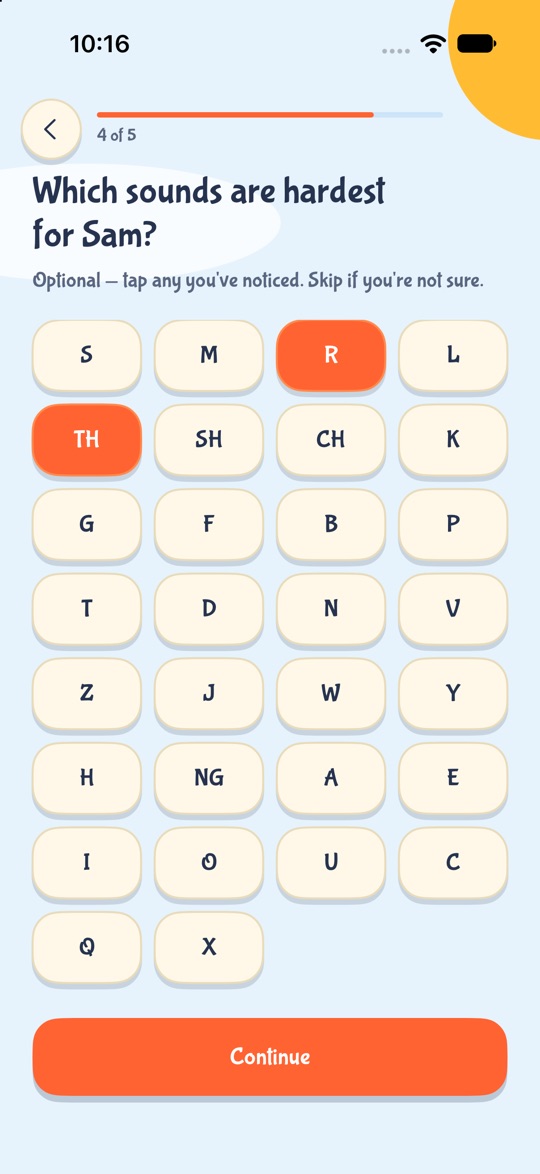
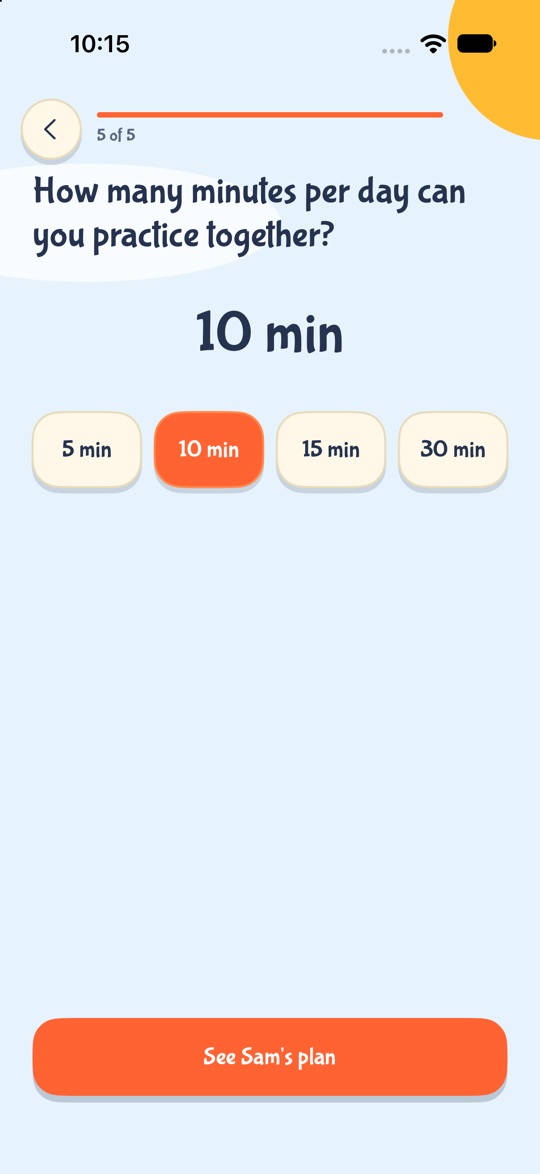
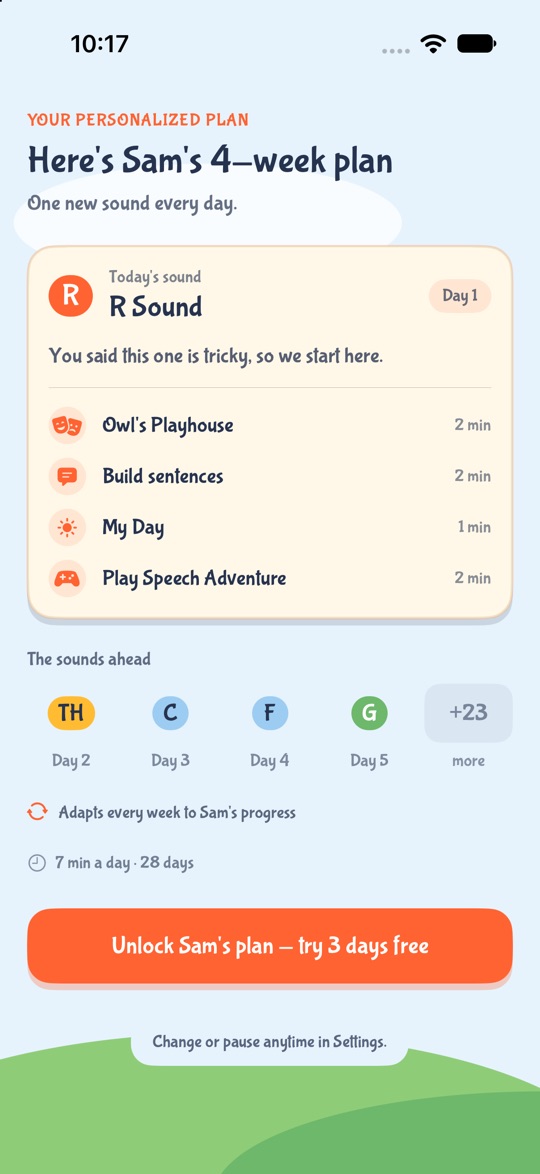
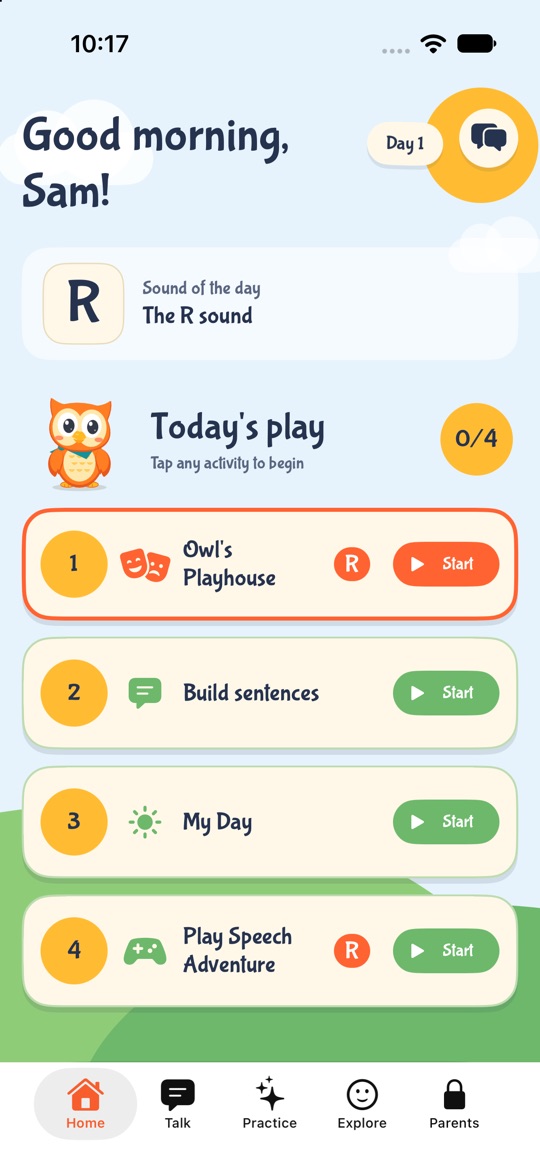
These are real screens from the app. A parent answers the questions, picks R and TH as the hard sounds, and gets a plan that starts with R.
Inside the app
See how the plan is made
These are the real setup screens in Help Me Talk. You answer five short questions and the app builds a 4-week plan, one sound a day.
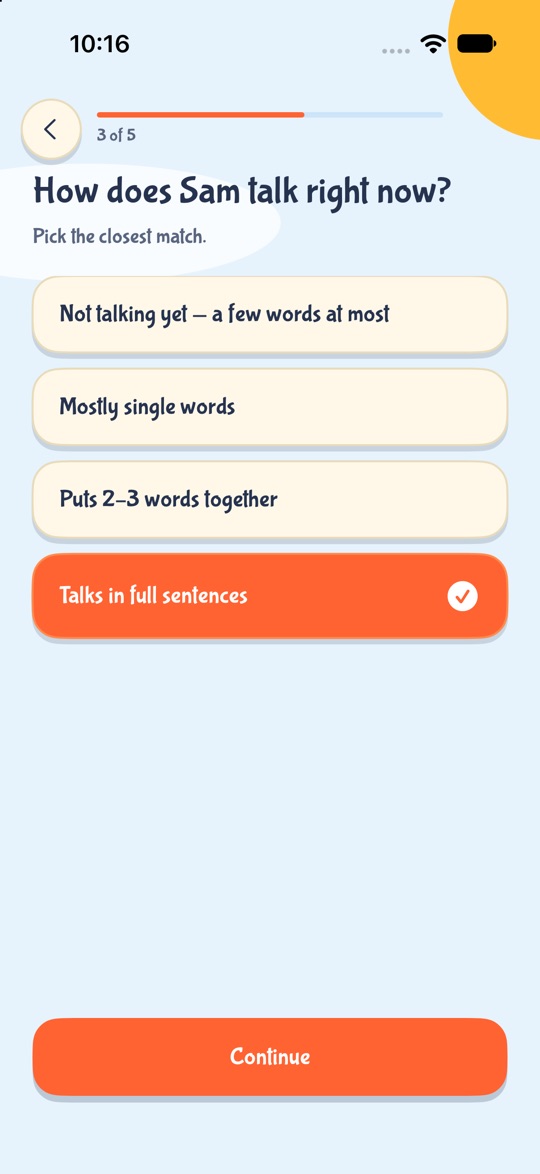
1. Say how your child talks
Name, age, then how they talk today. Pick the closest match.
Try it with your child. Free to download.
The five setup questions
The setup takes about a minute. There is no recording step. The plan is built from your answers alone.
| Question | What you choose | What it changes |
|---|---|---|
| What's your child's first name? | Any name | The plan and greetings use it |
| How old is your child? | Years and months | The order of the sounds after your picks |
| How does your child talk right now? | Not talking yet, single words, 2 to 3 words together, or full sentences | How long the sentences are in Build sentences |
| Which sounds are hardest? | Any of the sounds, or skip | These sounds go first in the plan |
| How many minutes a day can you practise? | 5, 10, 15 or 30 minutes | How long each activity runs |
What a day looks like
Every day has one sound of the day and the same short set of cards, in the same order. Your child always knows what comes next.
- 1Owl's Playhouse on the day's sound. A short show of five turns where your child says words with that sound, and a good try makes Pip the owl act the word out.
- 2Build sentences. Your child taps pictures to make a sentence and hears it read out. See the picture sentence builder.
- 3My Day. About one minute with your child's picture schedule. See the visual schedule.
- 4A game on the sound. Speech Adventure one day, Word Bubbles the next, so the game changes daily.
- 5Feelings, on some days. When the day's sound starts a feeling word, like S for sad or T for tired, a Feelings card is added.
| Minutes you pick | Each sound activity | A 4-card day |
|---|---|---|
| 5 minutes | About 2 min | About 7 min |
| 10 minutes | About 2 min | About 7 min |
| 15 minutes | About 3 min | About 10 min |
| 30 minutes | About 7 min | About 22 min |
How the plan changes over 4 weeks
Tries the app could not hear, for example in a noisy room, do not count as fails. Only clear yes, almost or no results count toward the weekly decision.
| When | What happens |
|---|---|
| Day 1 | The first sound you flagged. With no flags, a sound that suits your child's age. |
| Days 7, 14, 21 and 28 | A quick check-in on one of the plan's main sounds takes the first slot, to measure progress. Children at the single-word stage keep normal practice. |
| Days 8, 15 and 22 | The plan looks at the past week. A sound passed more than 80% of the time (5 tries or more) leaves the focus and the next one moves up. A sound passed less than 30% of the time stays, at an easier level. |
| Day 14 | A card asks if you feel progress. If you answer "Not really", the plan is retuned right away. |
| Day 28 | A summary of days practised and activities finished. The next 4-week plan builds on your child's progress. |
How to get the most from it
- 1Pick a fixed time, like after school or before the bath. The same time each day builds the habit.
- 2Sit with your child. Say the words too, and praise the trying, not only the right answers.
- 3Be honest in the setup. If you are not sure which sounds are hard, skip that question. The age order is a good start.
- 4Answer the day 14 check-in. It is the fastest way to tell the plan it needs to change.
- 5On iPhone and iPad, set a reminder time in Settings. If a few days pass with no practice, a gentle reminder arrives.
Problems and fixes
| What happens | Try this |
|---|---|
| You miss a day or two | Just pick up where you left off. Short and regular still beats perfect. |
| Your child gets tired before the end | Pick fewer minutes. Two cards today is better than a fight. |
| The sound of the day is too easy | Easy days build confidence. The weekly check moves mastered sounds out of the focus. |
| The sound is too hard and your child gets upset | Do the game card only, then stop. A low pass rate makes the plan go easier on that sound. |
What the plan does not do
It is not a diagnosis or a speech assessment, and it does not replace a speech therapist. If you are worried about your child's speech, talk to your doctor or a speech-language pathologist. Many families use the plan for practice between sessions.
You can't write your own day-by-day schedule. You shape the plan through the setup answers, and the app sets the order. The app has no recording step in the setup, so the first week is based on what you tell it.
The sounds, words and voice are in English only. The plan is part of the subscription. You can try the whole app free for 3 days, then it is $9.99 a month or $49.99 a year in the US.
Practice these sounds
Free word lists, mouth-position guides and games. No app needed.
Questions parents ask
- How long does it take each day?
- With Help Me Talk's default of 10 minutes a day, a plan day is about 7 minutes: three activities of about 2 minutes and a one-minute My Day card.
- How does the app choose the sounds?
- Help Me Talk puts the sounds you mark as hard first. The rest follow in an order based on your child's age, with sounds most children their age are still learning before ones they usually have already.
- What happens after 4 weeks?
- Help Me Talk shows how many days you practised and how many activities you finished. Then a new 4-week plan starts that builds on your child's progress.
- Does the plan change if my child improves?
- Yes. On days 8, 15 and 22 Help Me Talk checks the past week. A sound your child passes more than 80% of the time leaves the focus and the next sound moves up.
- What if we miss a day?
- Nothing breaks. Help Me Talk keeps your plan, and you carry on from the app. On iPhone and iPad a reminder arrives after a few days without practice.
- Is it right for a child who isn't talking yet?
- Help Me Talk asks how your child talks and adjusts. For a child who is not talking yet or uses single words, Build sentences stays at one word. A child at that stage may also need picture tools and a speech therapist's help.
- Does it work on Android?
- Yes. The same setup questions and 4-week plan are in Help Me Talk on iPhone, iPad and Android. A subscription on one store does not carry over to the other.
- Is the plan free?
- The plan is part of the Help Me Talk subscription. A 3-day free trial unlocks the whole app, then it is $9.99 a month or $49.99 a year in the US. Prices vary by country.
Keep reading
- How to do speech therapy at home
- Speech therapy exercises for kids
- Build a sentence with pictures
- A visual daily schedule your child can hear
- Help your child say how they feel
- The 18-month speech checklist
- The 2-year-old speech checklist for your child
- The 3-year-old speech checklist for your child
Last updated 23 October 2026.