Feature
Help your child say how they feel
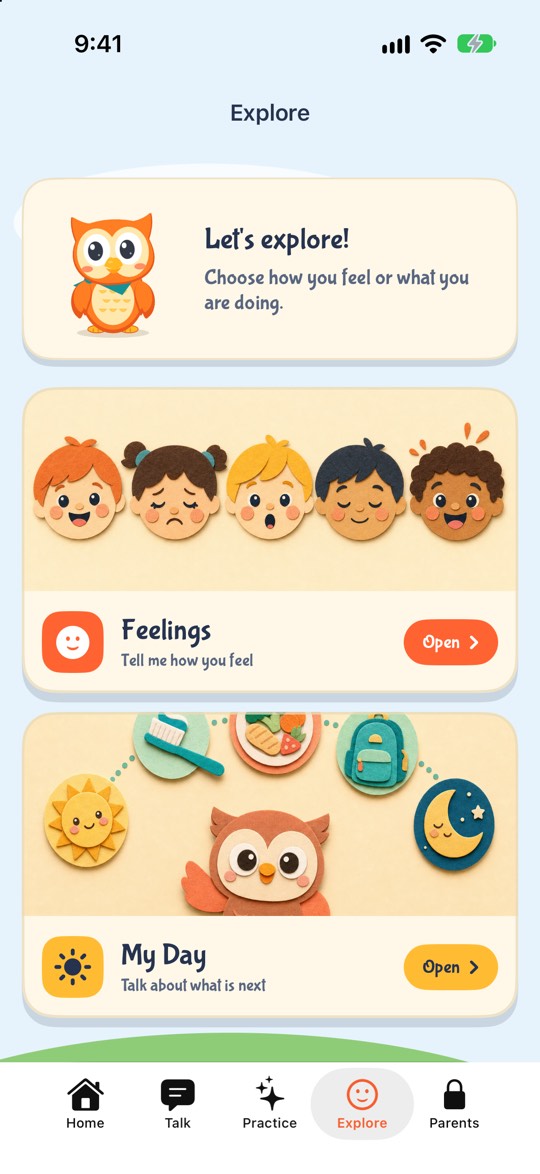
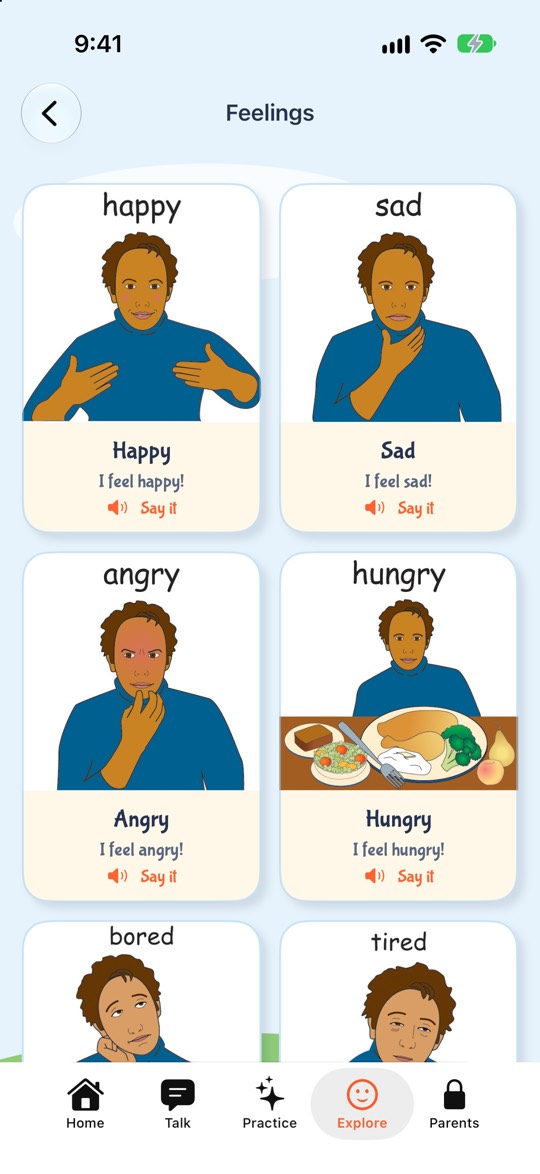
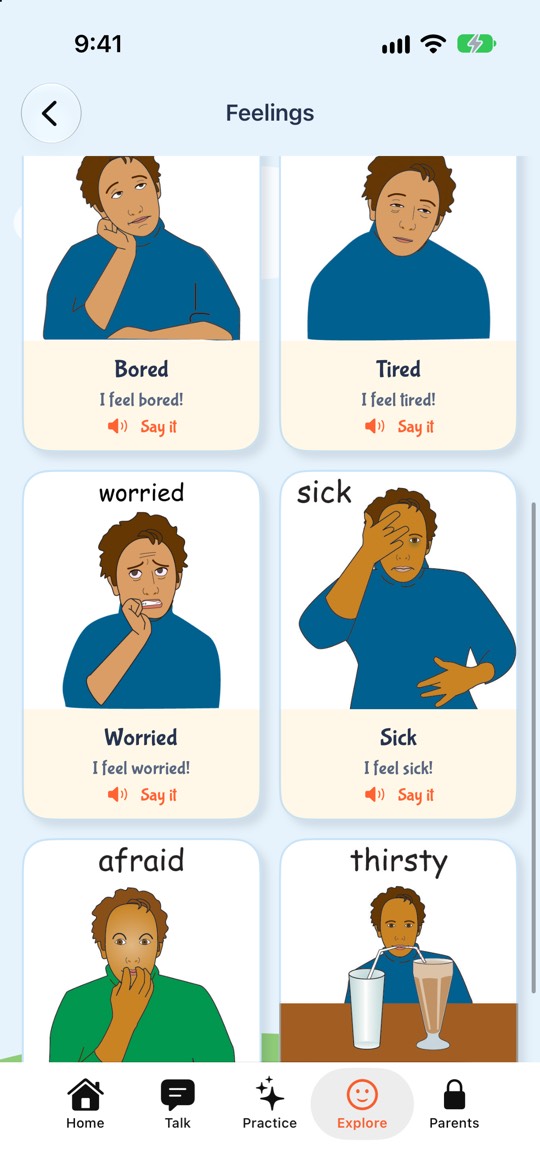
Feelings is the emotions board inside Help Me Talk. It shows ten feeling cards, like happy, tired and worried. Your child taps the one that matches how they feel, and the app says it as a full sentence: "I feel tired!" It gives a child who can't find the words a quick way to tell you, and a sentence they can learn to say themselves.
The short answer
Open Explore, then Feelings. Your child taps a card and hears "I feel ...!" out loud. There are ten feelings: happy, sad, angry, hungry, bored, tired, worried, sick, afraid and thirsty. It works on iPhone, iPad and Android, in English, and it is part of the Help Me Talk subscription.
US prices for iOS and Android. Prices vary by country; your store shows the price before you subscribe. The new prices are active on Google Play and take effect on the App Store on October 8, 2026.
Why naming feelings is hard for young children
A child who is tired or worried often shows it before they can say it. They cry, hide, refuse food or get cross. Adults then have to guess, and a wrong guess can make it worse.
Naming a feeling takes two things: knowing the word, and finding it in the moment. A picture helps with both. Your child does not have to remember "worried". They only have to point to the face that looks like they feel.
- One tap is easier than a sentence. The card does the talking.
- Hearing it builds the words. Each tap says the full sentence, so your child hears "I feel ..." again and again.
- It starts a conversation. "You picked worried. What's worrying you?"
Watch it work
These are real screens from the app. A child opens Feelings, taps Happy, and the app says the sentence.
Inside the app
See how a child says how they feel
This is Feelings in Help Me Talk. Your child picks the face that matches how they feel, and the app says it as a sentence.
1. Open Feelings
It sits in the Explore tab, next to My Day.
Try it with your child. Free to download.
The ten feelings
Every card shows a person acting out the feeling, the word, the sentence, and a Say it button. Some are emotions and some are body states, because a young child often can't tell "angry" from "hungry" yet.
| Feeling | The app says | Type |
|---|---|---|
| Happy | I feel happy! | Emotion |
| Sad | I feel sad! | Emotion |
| Angry | I feel angry! | Emotion |
| Worried | I feel worried! | Emotion |
| Afraid | I feel afraid! | Emotion |
| Bored | I feel bored! | Emotion |
| Tired | I feel tired! | Body |
| Hungry | I feel hungry! | Body |
| Thirsty | I feel thirsty! | Body |
| Sick | I feel sick! | Body |
How to use it at home
- 1Practise when your child is calm. Go through the cards together and act out each face.
- 2Use your own feelings too. Tap tired at the end of the day and say "I feel tired, so I'm going to sit down."
- 3Make it a daily check-in. At breakfast or after school, ask "How do you feel?" and let your child tap a card.
- 4When your child is upset, offer two cards, not ten. "Are you angry or sad?" is easier to answer.
- 5After they tap, say the sentence back and add one thing: "You feel sad. You miss Grandma."
- 6Praise the telling, not the feeling. Every feeling is allowed. Saying it is the skill.
Problems and fixes
| What happens | Try this |
|---|---|
| Your child always taps happy | That's fine at first. Model other feelings on your own turn, so they see every card is OK to use. |
| They are too upset to use the screen | Wait until they are calmer. Use the cards to talk about it afterwards. |
| They tap cards just to hear the sound | Let them. Hearing each sentence many times is how the words stick. |
| The feeling they have is not on a card | Pick the nearest one together, then use your own words for the rest. |
What Feelings does not do
It has ten fixed feelings. You can't add your own feelings or photos to this board. If you want your own pictures, Make Sentence lets you add photos.
It does not track moods over time or give advice about behaviour. It is not a therapy or a diagnosis. If your child's feelings or behaviour worry you, talk to your doctor or a child therapist.
The cards and the voice are in English only. Feelings is part of the subscription. You can try the whole app free for 3 days, then it is $9.99 a month or $49.99 a year in the US.
Questions parents ask
- What feelings are in the app?
- Help Me Talk's Feelings board has ten cards: happy, sad, angry, hungry, bored, tired, worried, sick, afraid and thirsty.
- What happens when my child taps a feeling?
- Help Me Talk says the feeling as a full sentence out loud, for example "I feel worried!", so your child hears the words they can use.
- What age is a feelings board good for?
- Many children start naming simple feelings like happy and sad between 2 and 4 years old. Help Me Talk's Feelings board suits that stage, and older children with a language delay can use it too.
- Can I add my own feelings?
- No. The Feelings board in Help Me Talk has ten fixed cards. You can add your own photos in Make Sentence instead.
- Is it useful for autistic children?
- Picture cards for feelings are widely used with autistic children because they make emotions easier to point to than to say. Help Me Talk's Feelings board is a simple version with sound. Ask your child's therapist how it fits their goals.
- Does it track my child's mood?
- No. Help Me Talk's Feelings board says the feeling out loud. It does not keep a mood diary or show mood charts.
- Does it work on Android?
- Yes. The same ten feelings are in Help Me Talk on iPhone, iPad and Android. A subscription on one store does not carry over to the other.
- Is it free?
- Feelings is part of the Help Me Talk subscription. A 3-day free trial unlocks the whole app, then it is $9.99 a month or $49.99 a year in the US. Prices vary by country.
Keep reading
- A visual daily schedule your child can hear
- Build a sentence with pictures
- Speech apps for autistic children
- Speech delay vs language delay
- The 3-year-old speech checklist
- A 4-week speech practice plan, made for your child
- The 18-month speech checklist
- The 2-year-old speech checklist for your child
Last updated 22 October 2026.