Guide
How to teach the R sound
R is the hardest sound in English to teach, because you cannot see it. The tongue does the work inside the mouth, and a child has to find the right shape by feel. The good news is that the steps are clear, and they work in the same order for most children. This guide shows what to check first, three ways to help your child find the sound, and how to make it last in real talking.
The short answer
First check your child is old enough, because most children do not settle R until 6 or 7. Then pick one way to find the sound (a growl, an "ee" slide, or the tongue-tip shape), hold it for a few seconds, and move up one step at a time: sound alone, words, phrases, sentences, talking. Practise five minutes a day. Expect weeks, not days.
Check the age before you start
Many children say "wabbit" for "rabbit" at four and five. This is the most common speech swap in English, and it is usually just a stage. Most children get a clear R between 6 and 7, and some take until 8.
So the first question is not how to fix R. It is whether R is ready to be fixed. The table below is a rough guide. It is not a test, and every child is different.
| Age | What is usual | What to do |
|---|---|---|
| Under 4 | R sounds like W ("wed" for "red") | Nothing. Talk, read and play. Do not correct. |
| 4 to 5 | R still like W, or clear in only a few words | Listen and play sound games. Practice is optional. |
| 5 to 6 | Some clear R in easy words, W in others | A good time for gentle practice if your child is keen. |
| 6 to 7 | Most children have a clear R | If W swaps remain, start the steps below. |
| Over 7, still no clear R | R is wrong, or speech is hard to follow | Start the steps below and ask a speech-language pathologist for a check. |
Step 1: Help your child hear the difference
A child who says "wabbit" often hears their own R as correct. They are not being lazy. Their ear has not yet learned that R and W are different sounds. So begin with listening, not speaking.
- 1Judge game. Say "red" and "wed" in a random order. Your child says which one you said, or gives a thumbs up for the right R.
- 2Catch the grown-up. Say a word with the wrong sound on purpose, such as "wun" for "run". Children enjoy catching an adult out.
- 3Same or different. Say two words, like "rock" and "wock", and ask if they match.
- 4Do this for a few days before you ask for any R from your child.
Step 2: Find the sound, three ways
There is no single right way to make R. Some people curl the tongue tip back. Others pull the whole tongue back and bunch it. Both give a good R. So try the three ways below, and keep the one that works for your child.
Sit next to your child at a mirror. Stay light and playful. If it is not working after a few minutes, stop and try again tomorrow.
For all three, check the lips. If they round like a W, the child is making a W. Ask for a small smile instead. The sides of the tongue should touch the upper back teeth, and the tip should stay off the roof of the mouth.
| Way to find R | What to say to your child | Good for |
|---|---|---|
| The growl | "Growl like a tiger. Make it long and rumbly." | Children who like animal play and pirate voices |
| The ee slide | "Say eee, then slowly pull your tongue back and keep the sound going." | Children who can say "ee" but not R |
| The tongue-tip shape | "Lift the tip of your tongue and curl it back a little. Do not touch the roof." | Children who like to copy a clear picture |
Step 3: Hold the sound alone
When your child makes a good R, even once, praise it and ask for it again. Then ask them to hold it for three seconds, like a growl. A long R is easier to feel than a short one.
Keep going until they can make a clear R about eight times out of ten. Only then move to words. If you skip this step, the R tends to vanish the moment a real word is added.
Step 4: Build up one step at a time
Each step below needs its own practice. Do not move up until the step before feels easy. A child can be at a different step for different words, and that is fine.
Many therapists start with R at the start of a word, because that R is usually easier. The R that comes after a vowel, like the one in "car" or "bird", is often harder. Our guide to vocalic R explains those and which one to try first.
Help Me Talk works the same way. The R sound has a level that shows how to say R, then words, 50 phrases and 50 sentences, so you can follow the ladder in order.
| Step | What your child says | Example |
|---|---|---|
| Sound alone | A long R | rrrrr |
| R at the start of a word | Short words first | red, run, rain, rock |
| R in the middle | Two-syllable words | carrot, parrot, berry |
| R at the end | A vowel plus R | car, door, bear |
| Phrases | Two or three words | red rug, run fast |
| Sentences | One full sentence | The red car is fast. |
| Real talking | Chat, a story or a game | Tell me about your day. |
A simple five-minute routine
Count the good tries, not the mistakes. A child needs many good repetitions for R to become automatic. Aim for 30 to 50 clear tries across a session if your child has the energy, and stop earlier if they do not.
- 1Warm up (1 minute). Do the growl or the ee slide a few times at the mirror.
- 2Listen (1 minute). Play the judge game with two or three word pairs.
- 3Practise (2 minutes). Say eight to ten words at your current step. Say each one with your child, then let them say it alone.
- 4Play (1 minute). End with a game, like pirate talk. Always end on a win.
- 5Same time each day. After a bath or before a story works well. Short and daily beats long and rare.
Problems and fixes
Most children get stuck at the same few places. Here is what to try.
| Problem | Why it happens | What to try |
|---|---|---|
| Still says W | The lips round, or the tongue stays low | Ask for a small smile. Go back to the growl and the ee slide. |
| R sounds muffled | The tongue is too flat or too far forward | Ask for a taller back of the tongue. Try the tongue-tip shape at the mirror. |
| Clear alone, gone in words | The step up was too big | Go back one step and add only the first sound of the word. |
| Good at the start of words, not at the end | R after a vowel has a different shape | Practise car, door and bear as their own step. See the vocalic R guide. |
| Good in practice, gone in talking | It is not yet automatic | Stay at the sentence step longer. Praise it when you hear it during the day. |
| Child gets upset | The task is too hard or too long | Cut the session to two minutes. Go back to listening games. |
Let your child hear their own R
Children often cannot hear their own mistakes. A recording helps, because they hear the difference when it plays back. Some children also like a score, because it turns practice into a game to beat.
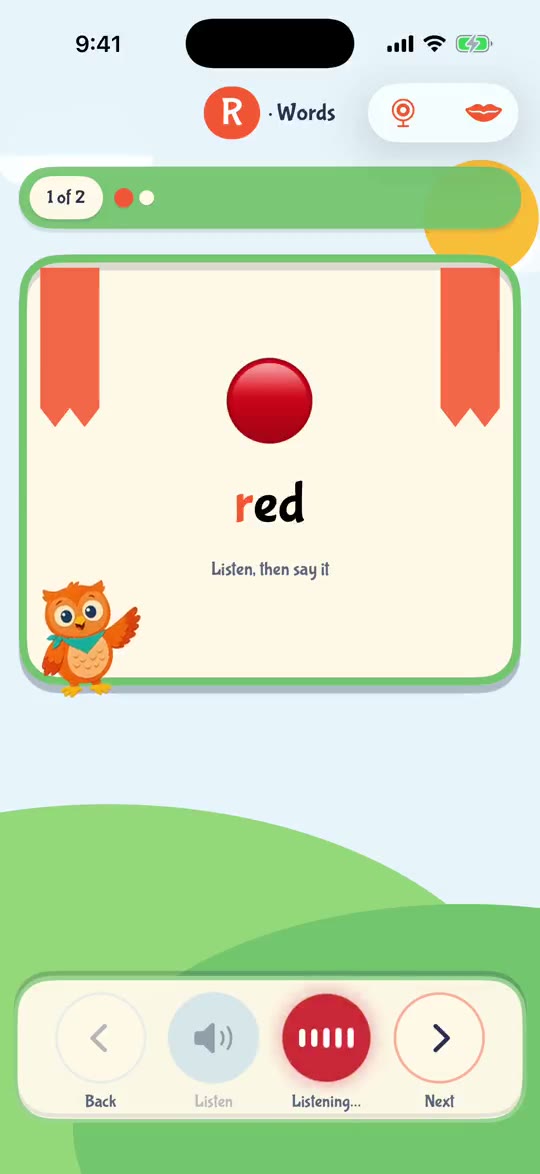
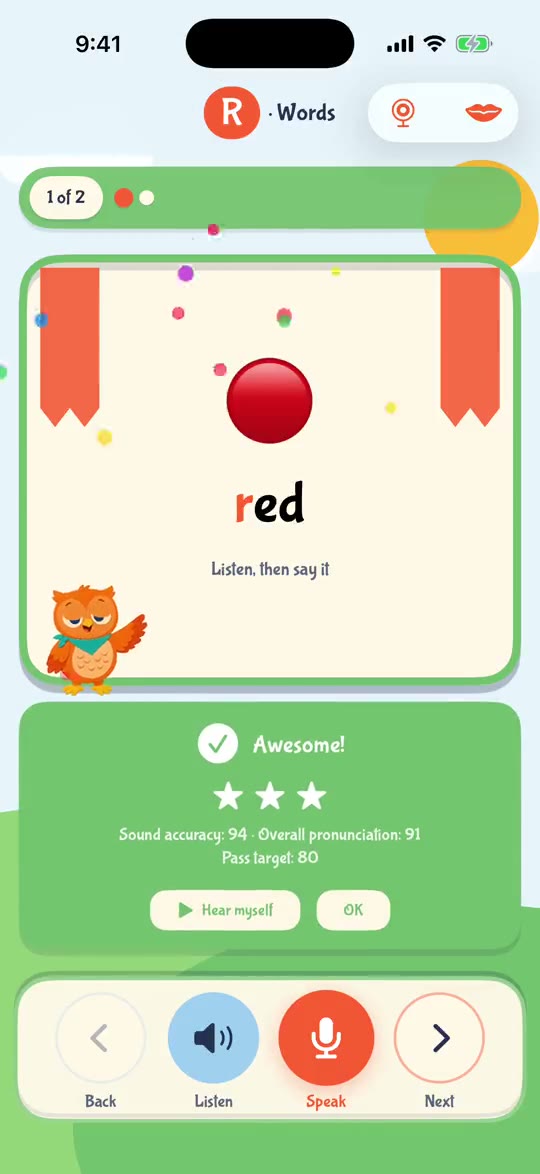
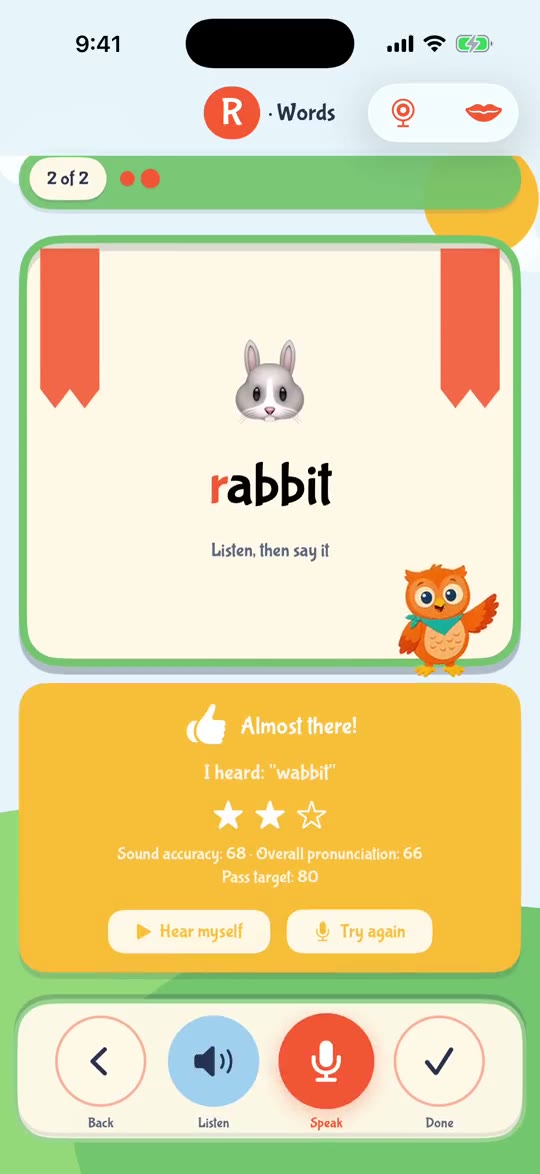
In Help Me Talk, your child says the word and the app listens. It gives a sound accuracy score, with a pass target of 80. If the R slips, it says what it heard, for example "wabbit", and asks for another try. It does not replace a speech-language pathologist. It gives the repeats, which are the part that is hard to fit into a busy day.
Inside the app
See a practice session, step by step
This is the R sound in Help Me Talk. Your child says the word, the app scores the attempt and asks for another try when the sound slips.
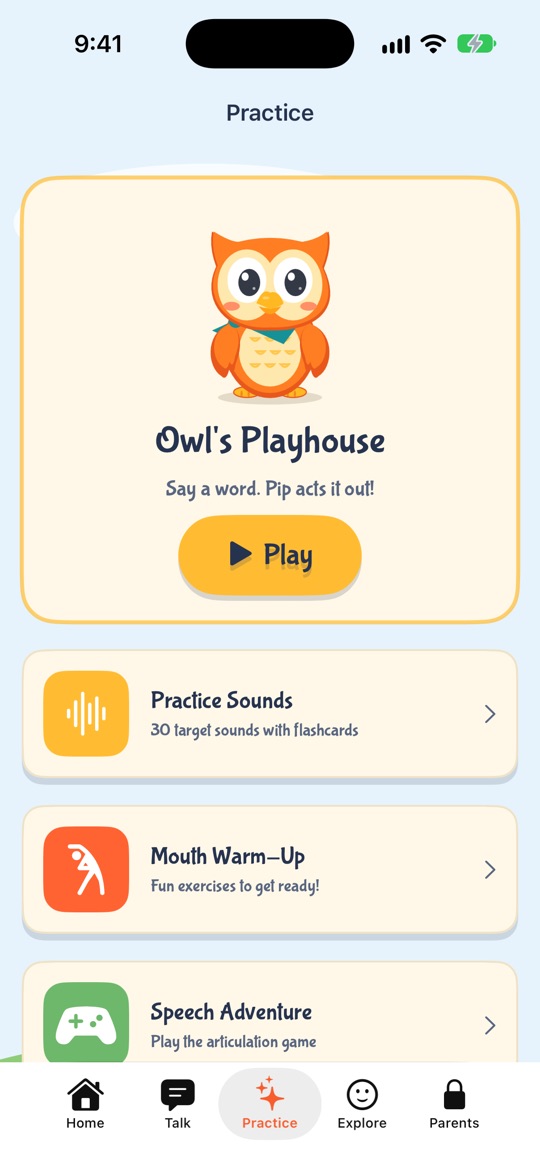
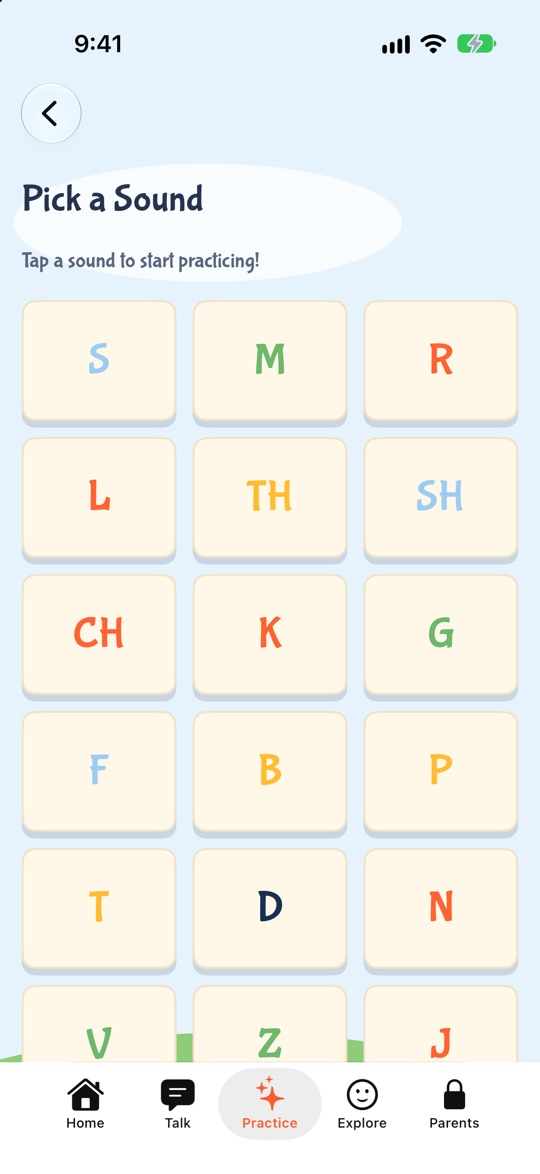
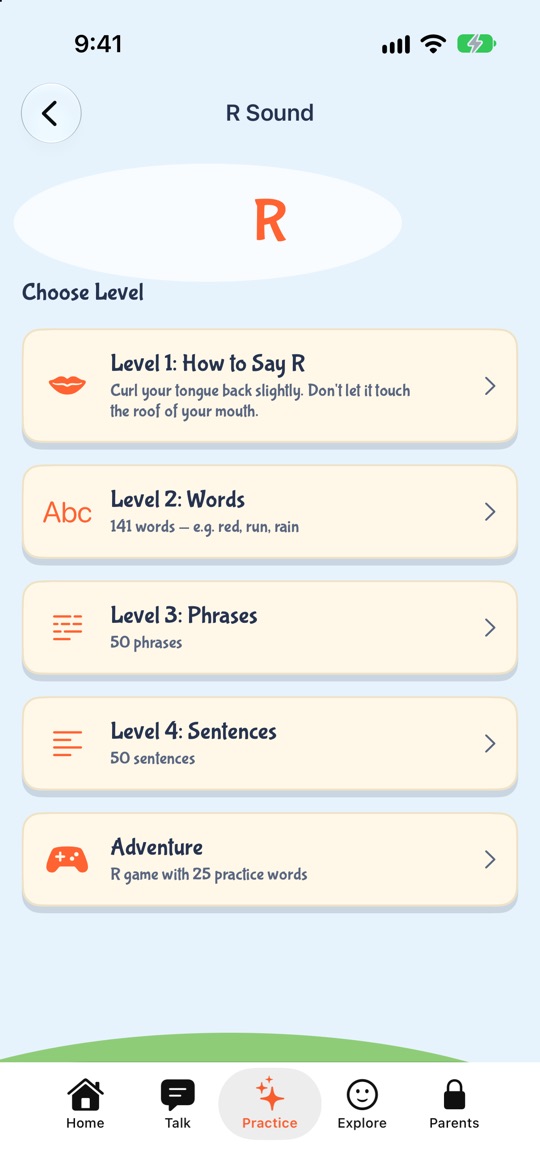
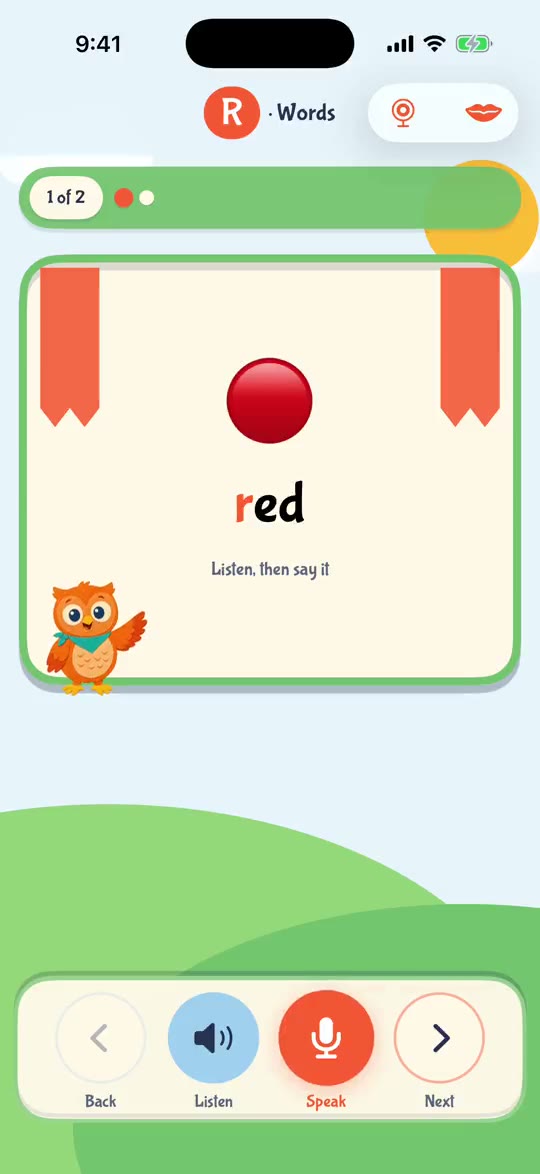
1. Open Practice Sounds
30 target sounds, each with words, phrases and sentences.
Try it with your child. Free to download.
When to ask for help
Ask a speech-language pathologist if your child is over 7 and has no clear R, if other sounds are also wrong, if family and friends often cannot follow their speech, or if your child feels upset about how they talk. A therapist can see the mouth shape and give feedback that no guide can.
If your child is under 5 and says W for R, there is usually nothing to fix. Wait, play, and listen.
Practice these sounds
Free word lists, mouth-position guides and games. No app needed.
Help Me Talk is a practice app, not a diagnosis or a replacement for a licensed speech-language pathologist. If you are worried about your child’s speech, talk to your doctor or an SLP. This app is for the practice in between.
Questions parents ask
- What age should a child say the R sound?
- Most children say a clear R by 6 or 7. Some take until 8. A four-year-old who says "wabbit" is on schedule.
- How long does it take to teach the R sound?
- It varies a lot. Finding the sound can take a few days or several weeks. Making it automatic in talking often takes a few months of short daily practice.
- Should I correct my child when they say wabbit?
- Not in everyday talk. Say the word back correctly and move on. Save correcting for the short practice time, where it is part of a game.
- What if my child cannot make the R sound at all?
- Try the growl, the ee slide and the tongue-tip shape in turn. If none works after a few weeks, ask a speech-language pathologist to look. Some children need a different cue.
- Is it a problem if my child's tongue curls up for R?
- No. Some people use a curled tip and some use a bunched tongue. Both can sound the same. Keep the one that works.
- Which R should we practise first?
- Start with R at the start of short words, like red and run, unless a therapist told you otherwise. Then move to R after a vowel.
- Can an app teach the R sound?
- An app can give your child many tries and tell them how the sound went. It works best with an adult sitting beside them. It does not replace a speech-language pathologist for a child who is stuck.
Keep reading
- R sound: words, phrases and audio
- Vocalic R explained, with seven types
- 12 speech exercises to try at home
- How to do speech therapy at home
- A 4-week speech practice plan
- Track the R sound week by week
- The 18-month speech checklist
- The 2-year-old speech checklist for your child
Last updated 26 October 2026.