Guide
How to teach the TH sound
TH is one of the last sounds children learn. Many say "fumb" for "thumb" or "dat" for "that" well into school. The good news is that TH is one of the easiest sounds to show, because the tongue is in plain sight. This guide shows what to check first, how to help your child find the sound, and how to make it last in real talking.
The short answer
First check your child is old enough, because many children do not settle TH until 7 or 8. Then show the shape: a little bit of tongue between the teeth, and gentle air over it. Start with the quiet TH in "thumb", then the buzzy TH in "this". Move up one step at a time: sound alone, words, phrases, sentences, talking. Practise five minutes a day.
Check the age before you start
TH comes late. A five-year-old who says "free" for "three" is usually right on time. Most children get a clear TH between 6 and 8. So the first question is not how to fix TH. It is whether TH is ready to be fixed.
The table below is a rough guide. It is not a test, and every child is different.
| Age | What is usual | What to do |
|---|---|---|
| Under 4 | D or T for TH ("dat", "tum") | Nothing. Talk, read and play. Do not correct. |
| 4 to 5 | F or V for TH ("fumb", "vat"), or D for TH | Listen and play sound games. Practice is optional. |
| 5 to 6 | Clear TH in some words, F or D in others | A good time for gentle practice if your child is keen. |
| 6 to 8 | Most children get a clear TH | If F or D swaps remain, start the steps below. |
| Over 8, still no clear TH | TH is wrong, or other sounds are wrong too | Start the steps below and ask a speech-language pathologist for a check. |
Two TH sounds, and which to teach first
English has two TH sounds. They use the same tongue shape. The only difference is the voice.
The quiet TH is just air, like in "thumb" and "three". The buzzy TH turns the voice on, like in "this" and "mother". Put a hand on your throat and you can feel the buzz on the second one.
Teach the quiet TH first. It is easier to hear and easier to feel, because there is nothing to do except blow. Once your child has it, the buzzy one is a short step: same shape, add the voice.
| Quiet TH | Buzzy TH | |
|---|---|---|
| Voice | Off, only air | On, you feel a buzz |
| Example words | thumb, three, think, bath | this, that, they, mother |
| Common swap | F ("fumb") or T ("tree" for "three") | V ("vat") or D ("dat") |
| Teach | First | Second |
Step 1: Help your child hear the difference
A child who says "fumb" often hears it as right. F and TH sound very alike, even to adults on a phone call. So begin with listening, not speaking.
- 1Thumbs up, thumbs down. Say words with a real TH or a sneaky F. Your child gives a thumbs up for TH and a thumbs down for F.
- 2Catch the grown-up. Say "I have free fings" on purpose. Children enjoy catching an adult out.
- 3Same or different. Say pairs like "three" and "free", or "thin" and "fin", and ask if they match.
- 4Watch the mouth. Let your child look at your face as you say "thumb" and "fun". TH shows the tongue. F shows the top teeth on the lip.
Step 2: Find the sound
Sit next to your child at a mirror. Show the shape first, then ask them to copy it. Keep it a game.
Help Me Talk uses the same cue on its TH level: "Stick your tongue out a tiny bit between your teeth. Blow air gently." The tongue tip sits between the upper and lower front teeth. The lips stay open and do not touch the tongue.
- 1Tongue peek. Ask your child to show you a tiny bit of tongue between the teeth. See who can show the smallest bit.
- 2Blow. Keep the tongue there and blow gently, with no voice. That long, soft hiss is the quiet TH.
- 3Feather or tissue. Hold a small piece of tissue in front of the mouth. A good TH makes it move a little.
- 4Watch the lip. If the top teeth land on the bottom lip, that is an F. Ask your child to lift the lip away and let the tongue come forward.
- 5Add the buzz. When the quiet TH is easy, keep the same shape and hum. That is the buzzy TH.
Step 3: Hold the sound alone
When your child makes a good TH, even once, praise it and ask for it again. Then ask them to hold it for three seconds, like a slow puff of air. A long TH is easier to feel than a short one.
Keep going until your child can make a clear TH about eight times out of ten. Only then move to words. If you skip this step, the F tends to come back the moment a real word is added.
Step 4: Build up one step at a time
Each step below needs its own practice. Do not move up until the step before feels easy. A child can be at a different step for the quiet and the buzzy TH, and that is fine.
TH at the start of a word is usually easiest to start with, because the child can set up the tongue before any other sound. TH at the end, like in "bath", comes next.
Help Me Talk follows the same ladder. The TH level shows how to make the sound, then words, 50 phrases and 50 sentences, so you can work through it in order.
| Step | What your child says | Example |
|---|---|---|
| Sound alone | A long, quiet TH | thhhhh |
| Quiet TH at the start | Short words | thumb, three, think, thin |
| Buzzy TH at the start | Short words | this, that, they, them |
| TH at the end | A vowel then TH | bath, mouth, teeth |
| Phrases | Two or three words | a thick thumb, throw the ball |
| Sentences | One full sentence | I think there are three. |
| Real talking | Chat, a story or a game | Tell me about this picture. |
A simple five-minute routine
Count the good tries, not the mistakes. A child needs many good repetitions for TH to become automatic. Aim for 30 to 50 clear tries in a session if your child has the energy, and stop earlier if they do not.
- 1Warm up (1 minute). Tongue peek and a few long blows at the mirror.
- 2Listen (1 minute). Play thumbs up, thumbs down with three or four word pairs.
- 3Practise (2 minutes). Say eight to ten words at your current step. Say each one together, then let your child say it alone.
- 4Play (1 minute). End with a game, like counting "one, two, three" with a big TH on three. Always end on a win.
- 5Same time each day. After brushing teeth works well, since your child is already at a mirror.
Problems and fixes
Most children get stuck at the same few places. Here is what to try.
| Problem | Why it happens | What to try |
|---|---|---|
| Still says F ("fumb") | Top teeth rest on the lower lip | Mirror check. Lift the lip away and show a bit of tongue. |
| Says T or D ("tumb", "dat") | The tongue stops the air instead of letting it flow | Practise the long blow. TH should last as long as your breath. |
| Tongue pokes far out | Trying too hard | Ask for just the tip. See who can show the smallest bit. |
| Sounds wet or spitty | Too much air or the tongue is too flat | Blow more gently. Try the tissue test with a softer puff. |
| Clear alone, gone in words | The step up was too big | Go back one step. Say "th... umb" with a pause, then close the gap. |
| Good in practice, gone in talking | It is not yet automatic | Stay at the sentence step longer. Praise it when you hear it during the day. |
| Child gets upset | The task is too hard or too long | Cut the session to two minutes. Go back to listening games. |
TH and a lisp are not the same
Some children put the tongue between the teeth for S as well, so "sun" sounds like "thun". That is a lisp, and the fix is the opposite: the tongue needs to hide behind the teeth for S. If your child does this, see our guide on how to fix a lisp.
Teaching TH will not cause a lisp. Children learn that TH shows the tongue and S hides it. Practising both side by side can even help, because the difference is easy to see in a mirror.
Let your child hear their own TH
Children often cannot hear their own swaps, because F and TH sound so alike. A recording helps, because they hear the difference when it plays back.
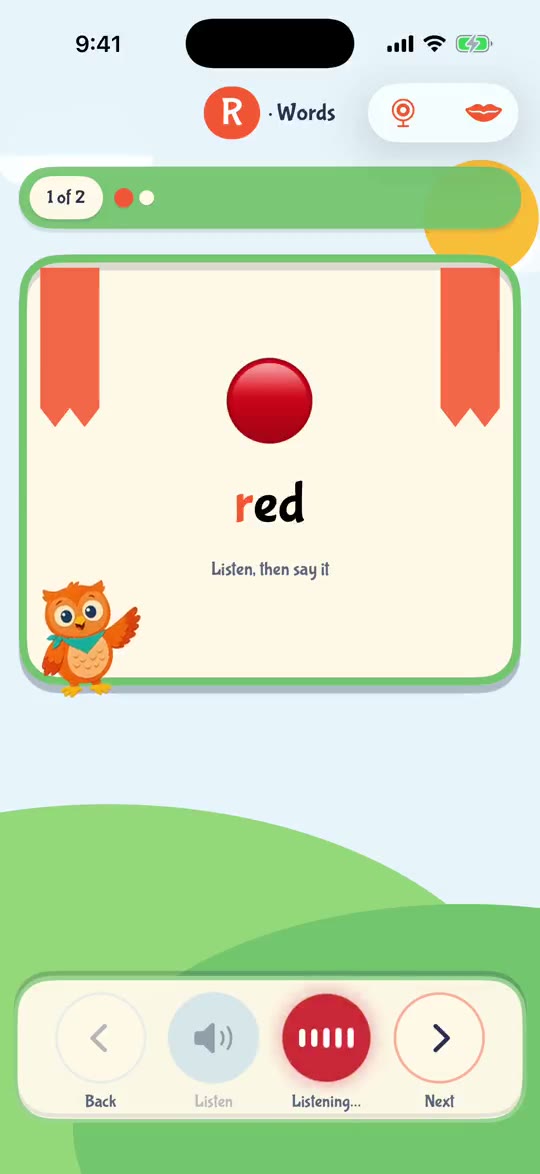
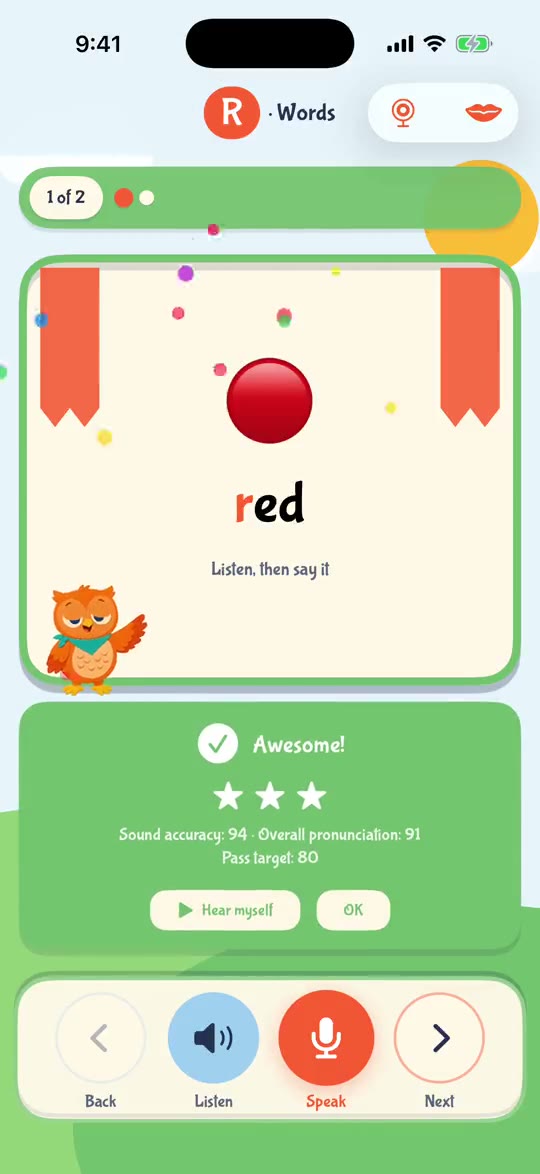
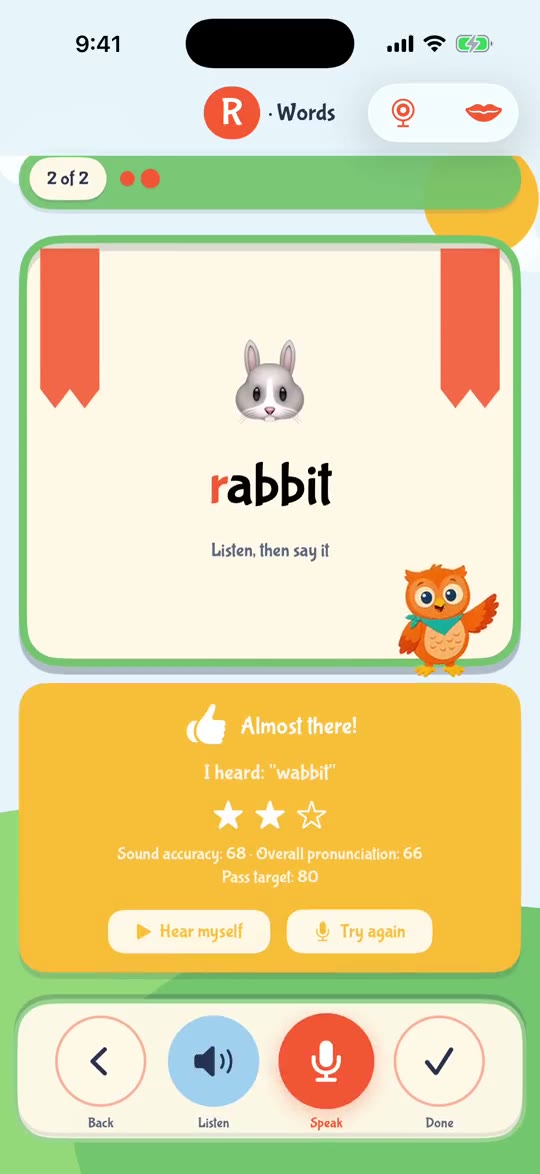
In Help Me Talk, your child says the word and the app listens. It gives a sound accuracy score, with a pass target of 80. If TH slips, it shows what it heard and asks for another try. The TH level is part of the Help Me Talk subscription. The app does not replace a speech-language pathologist. It gives the repeats, which are the part that is hard to fit into a busy day.
Inside the app
See a practice session, step by step
This is the R sound in Help Me Talk. Your child says the word, the app scores the attempt and asks for another try when the sound slips.
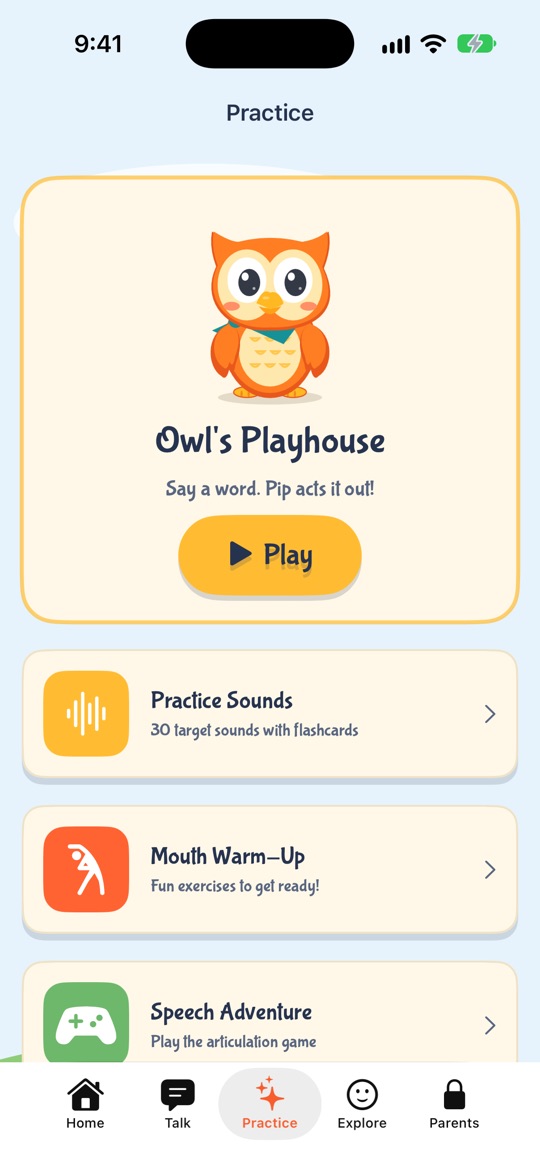
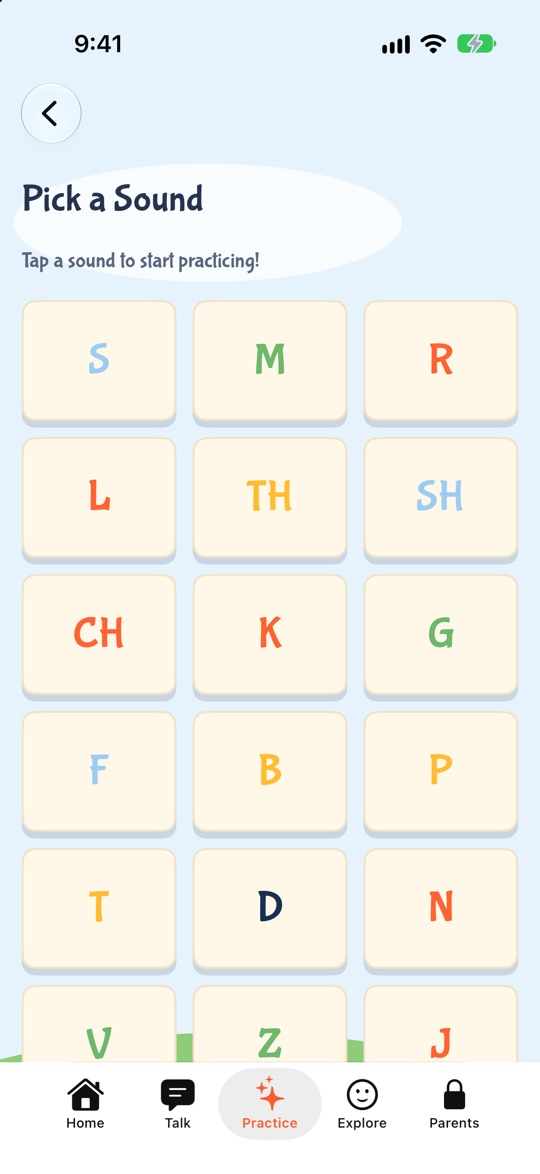
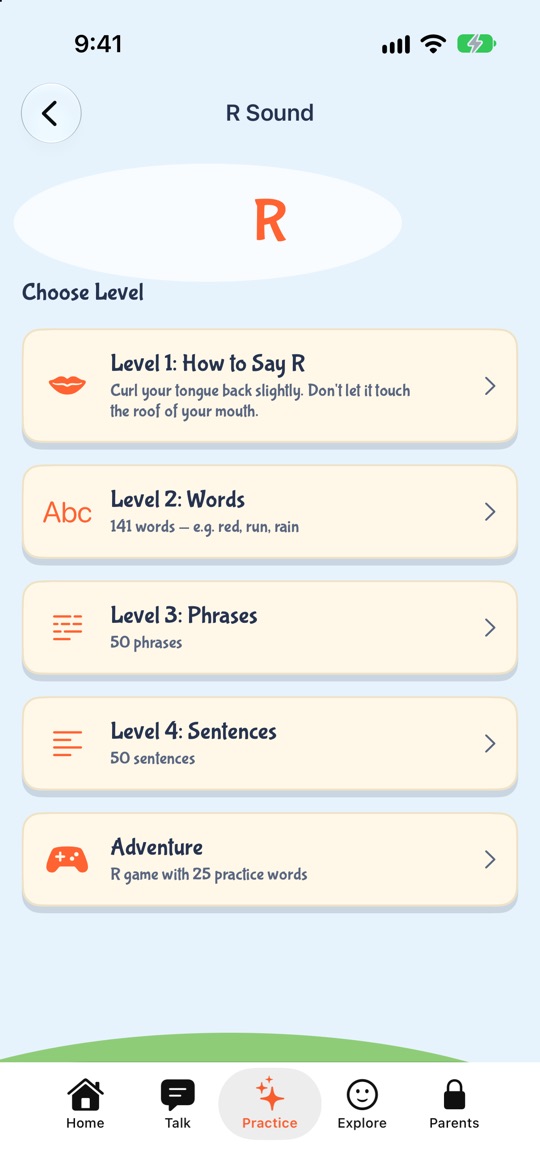
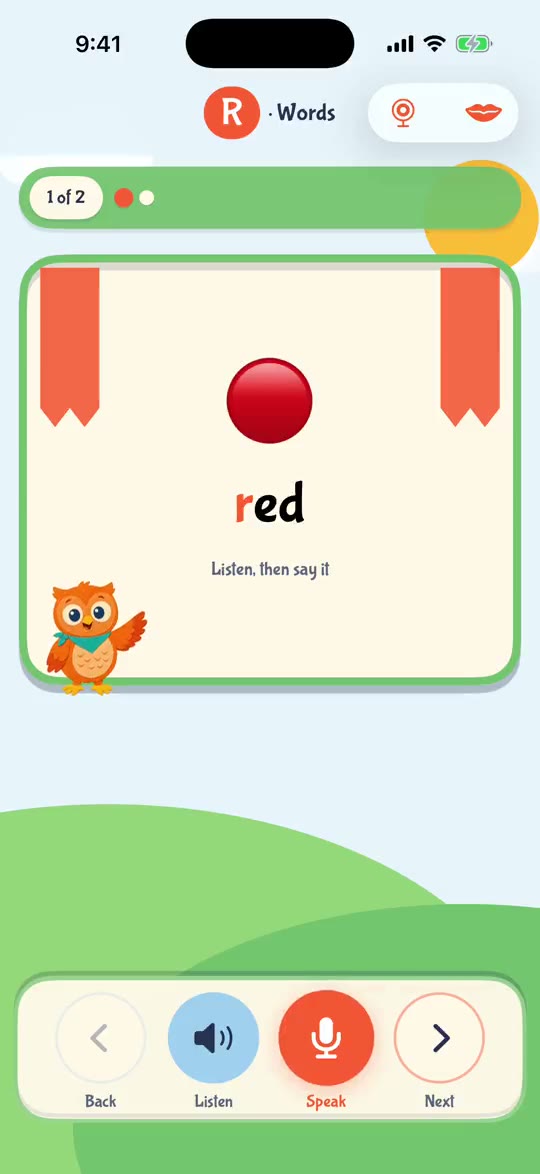
1. Open Practice Sounds
30 target sounds, each with words, phrases and sentences.
Try it with your child. Free to download.
When to ask for help
Ask a speech-language pathologist if your child is over 8 and has no clear TH, if other sounds are also wrong, if people often cannot follow their speech, or if your child feels upset about how they talk. A therapist can watch the mouth and give feedback that no guide can.
If your child is under 6 and says F or D for TH, there is usually nothing to fix. Wait, play, and listen.
Practice these sounds
Free word lists, mouth-position guides and games. No app needed.
Help Me Talk is a practice app, not a diagnosis or a replacement for a licensed speech-language pathologist. If you are worried about your child’s speech, talk to your doctor or an SLP. This app is for the practice in between.
Questions parents ask
- What age should a child say the TH sound?
- Many children get a clear TH between 6 and 8. A five-year-old who says "fumb" for "thumb" is usually on schedule.
- Why does my child say F instead of TH?
- F and TH sound very alike, and F is easier to make. The child puts the top teeth on the lip instead of showing the tongue. Most children grow out of it.
- Which TH should we teach first?
- Start with the quiet TH in words like thumb and three. Then add the voice for the buzzy TH in this and that.
- Should I correct my child when they say fumb?
- Not in everyday talk. Say the word back the right way and move on. Save correcting for the short practice time, where it is part of a game.
- Will teaching TH give my child a lisp?
- No. TH shows the tongue and S hides it. Practising both in a mirror can make the difference clearer.
- How long does it take to learn TH?
- Finding the sound is often quick, because the tongue is easy to see. Using it in everyday talk usually takes a few weeks to a few months of short daily practice.
- Can an app teach the TH sound?
- An app can give your child many tries and tell them how the sound went. It works best with an adult sitting beside them. It does not replace a speech-language pathologist for a child who is stuck.
Keep reading
- TH sound: words, phrases and audio
- How to fix a lisp in a child
- How to teach the R sound
- 12 speech exercises to try at home
- A 4-week speech practice plan
- The 18-month speech checklist
- The 2-year-old speech checklist for your child
- The 3-year-old speech checklist for your child
Last updated 29 October 2026.