Guide
Picture talker or speech practice app: which does your child need?
A picture talker speaks for your child. A speech practice app helps your child speak more clearly. They look alike in an app store, but they solve different problems. This guide gives you one question to start with, a table of common situations, a one-week check you can do at home, and what to do if your child needs both.
The short answer
Ask one question: can your child use spoken words to tell you what they want? If no, or only a few, look at a picture talker, also called an AAC app (AAC means augmentative and alternative communication, which is any way of communicating other than speech). If yes, but people find them hard to understand, look at a speech practice app. If yes, in single words only, a sentence-building picture board may fit. Some children need both, and using a picture talker does not stop a child from learning to talk.
US prices for iOS and Android. Prices vary by country; your store shows the price before you subscribe. The new prices are active on Google Play and take effect on the App Store on October 8, 2026.
Two kinds of app that look the same
Both kinds of app have pictures, a voice and bright buttons. The difference is who does the talking.
With a picture talker, your child taps pictures and the device speaks. The goal is to let your child say what they need today, even if speech is not there yet. With a speech practice app, your child does the talking. The goal is to make their own speech clearer, one sound at a time.
| Question | Picture talker (AAC) | Speech practice app |
|---|---|---|
| Who talks | The device speaks for your child | Your child speaks |
| Main goal | Say what they need, now | Say sounds and words more clearly |
| Used when | All day, wherever your child goes | A few minutes of practice, most days |
| Needs speech? | No | Yes. Your child must try a sound when asked |
| Set up by | Best chosen with a speech-language pathologist | Most parents can start on their own |
| Cost | Free to about $300, or more with a dedicated device | Usually a monthly or yearly subscription |
Start with one question
Forget age and diagnosis for a moment. Think about the last few days. How did your child tell you what they wanted? Find the row closest to your child.
| What your child does now | What usually fits | Why |
|---|---|---|
| No spoken words, or only a few | Picture talker, chosen with a speech-language pathologist | Your child needs a way to communicate now |
| Words come and go, and speech is very hard work | Ask for an assessment first. A picture talker may help while speech is worked on | Your child may need both, with professional help |
| Uses single words, but does not join them | Sentence-building picture board, plus daily talk at home | The next step is joining words |
| Talks in sentences, but strangers cannot understand | Speech practice, with an assessment if you are worried | The words are there. Clarity is the problem |
| Talks well, but says a few sounds wrong, like R, S or TH | Speech practice for those sounds | This is the job these apps were built for |
| Talks clearly, but conversations are hard | Speech-language pathologist | Apps do not treat this well |
When a picture talker is the right choice
A picture talker makes sense when speech cannot yet do the job your child needs it to do. That can be true at any age. A child does not need to reach a certain age or skill before trying one.
A full AAC system is more than a set of pictures. It has a large set of words, and each word stays in the same place on the screen, so your child can learn where it is, the way you find keys on a keyboard. That is why a speech-language pathologist should help you choose and set it up.
Look closely at a picture talker if any of these sound like your child:
- Your child gets very upset because they cannot tell you what they want.
- Your child has few words for their age and the number is not growing.
- Only close family can work out what your child means.
- Your child pulls you to things or points, instead of using words.
- A doctor or therapist has mentioned childhood apraxia, autism or another condition that makes speech very hard.
When a speech practice app is the right choice
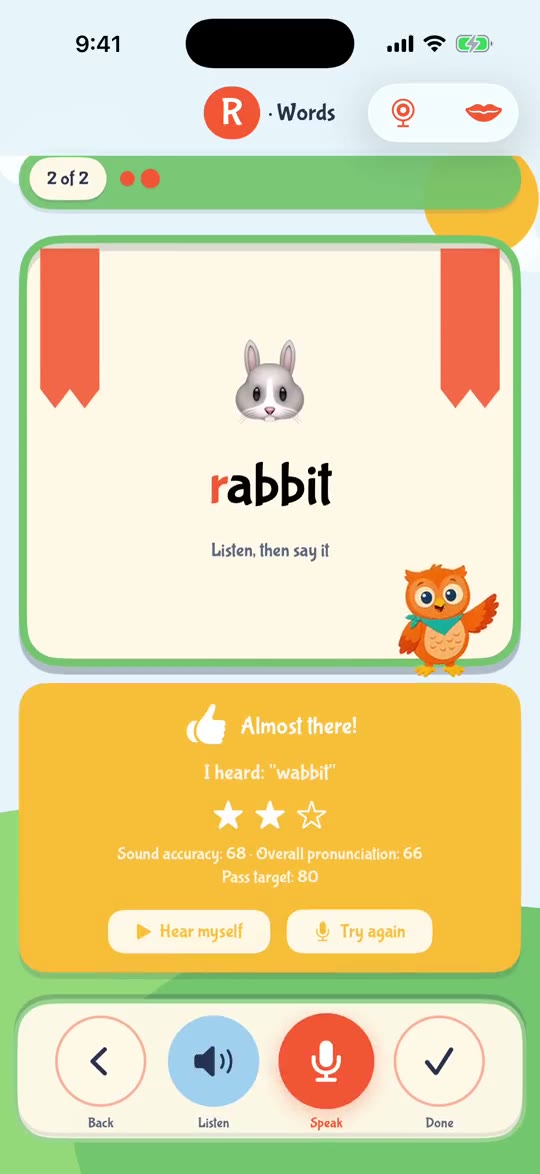
A speech practice app makes sense when your child has words but some sounds are not clear. Common examples are saying "wabbit" for rabbit, "thun" for sun, or dropping the ends of words.
Your child needs to be able to try a sound when you ask, which usually starts at around age 3. Your child also needs to be willing to do a few minutes of practice on most days. The app gives them more repeats than one weekly session can.
A practice app will not give words to a child who has none. If your child cannot yet copy a sound, it will likely sit unused. In that case, talk at home and play matter more, and our late talker guide is a better place to begin.
The child in the middle: single words
Many children sit between the two groups. They can say "juice" and "car", but not "I want juice". A full AAC system may be more than they need, and sound practice does not teach them to join words.
A picture board for sentences can fit here. Your child taps two or three pictures and hears a short sentence. They can then copy it. Our guide on helping a child speak in sentences shows how to do this with or without an app.
Will a picture talker stop my child from talking?
This is the worry most parents have, and the research points the other way. Studies find that AAC does not hold back speech, and it often supports it. Each time your child taps a picture, they hear the word. They also learn that communicating gets results, which is a good reason to keep trying.
Waiting has a cost too. A child with no way to communicate can spend months feeling unheard. You can use a picture talker and work on speech at the same time. Many children use less AAC as their speech grows, and some keep it for hard moments or for talking to new people.
When your child needs both
The two kinds of app do not compete. A child can use a picture talker to get through the day, and practise sounds for a few minutes when they are ready. Children also change over time. One who starts with AAC at age 3 may be speaking in sentences at 6, with only a few sounds left to work on.
If you use both, keep them apart. The picture talker is your child's voice, so it stays with them and is never a task. Practice is a short, set activity.
| Time | Picture talker | Speech practice |
|---|---|---|
| Meals and snacks | Yes. Ask for food and drink | No |
| Out and about | Yes. It goes with your child | No |
| When upset | Yes. Show the words for what they feel | Never |
| A calm 5 minutes | Optional | Yes |
| With a therapist | Follow their plan | Follow their plan |
A one-week check at home
If you are still not sure, spend a week watching before you pay for anything. This does not replace an assessment, but it gives you clear notes to take to one.
- 1Keep a note on your phone. For three days, write down each new word your child says on their own.
- 2Write down how your child asks for things: with words, by pointing, by pulling you, or by crying.
- 3Ask someone who does not live with you how much of your child's speech they understand.
- 4Say a simple word, like "ball", and ask your child to copy it. Try this a few times across the week, and stop if they are not interested.
- 5Make paper pictures of two snacks. Hold them up and let your child point to choose.
- 6Look at your notes. Few words and lots of pointing suggest a picture talker. Many words and unclear sounds suggest speech practice.
Problems and fixes
| What happens | Try this |
|---|---|
| Your child taps the same picture again and again | That is normal at first. They are exploring. Answer it each time. |
| Your child only uses the app for fun | Use it yourself. Tap the pictures while you talk, so they see how it works. |
| Your child refuses to practise sounds | Make it shorter. Try 3 minutes, and stop while it is still going well. |
| The practice app does not understand your child | Try a quieter room and hold the device closer. If it keeps failing, your child may need an easier level or a therapist's help. |
| Family members say "just make them talk" | Explain that the picture talker helps speech, and that it does not replace it. |
| School uses a different picture talker | Ask to use the same one at home. Your child should not have to learn two layouts. |
| You paid for an app and it does not fit | Stop and ask for an assessment before you buy another one. |
How to get the right advice
Ask your doctor for a referral to a speech-language pathologist, or contact one directly. If you think your child needs a picture talker, ask for an AAC assessment. It checks which layout, picture style and device suit your child, including how your child reaches the screen.
Ask about funding at the same visit, because schools, health plans and public programs may help pay in some places. Our guide on the cost of speech therapy explains what to ask. Do not wait for an appointment to start using simple pictures at home. A few paper cards for snacks and toys can help right away.
Where Help Me Talk fits
Help Me Talk is a speech practice app. It is not a full AAC system. We say this clearly because a child who needs AAC should not lose time with the wrong tool. If your child has no reliable way to speak, start with our comparison of AAC apps and a speech-language pathologist.
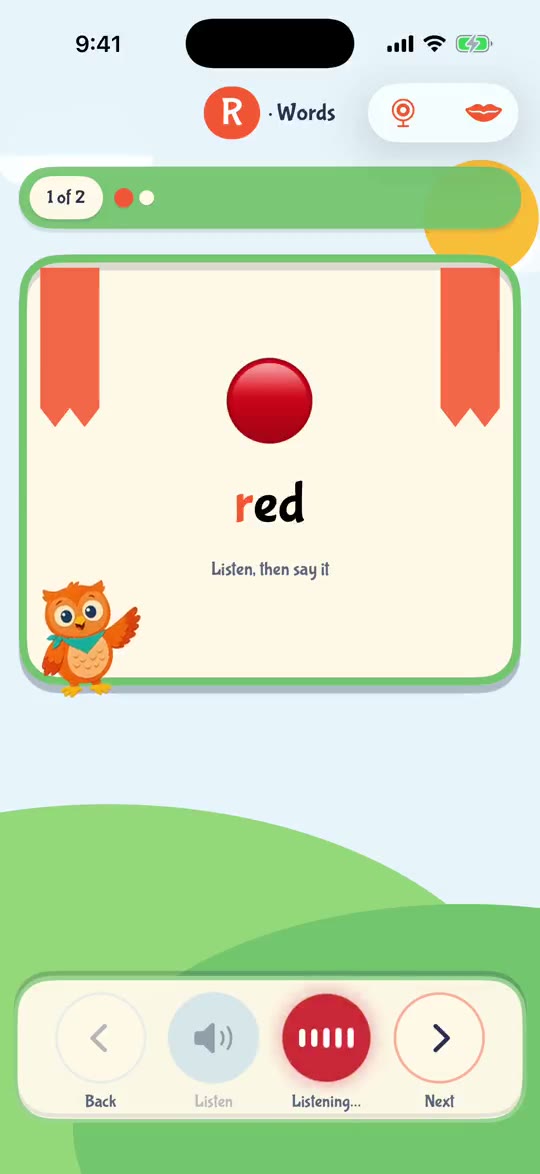
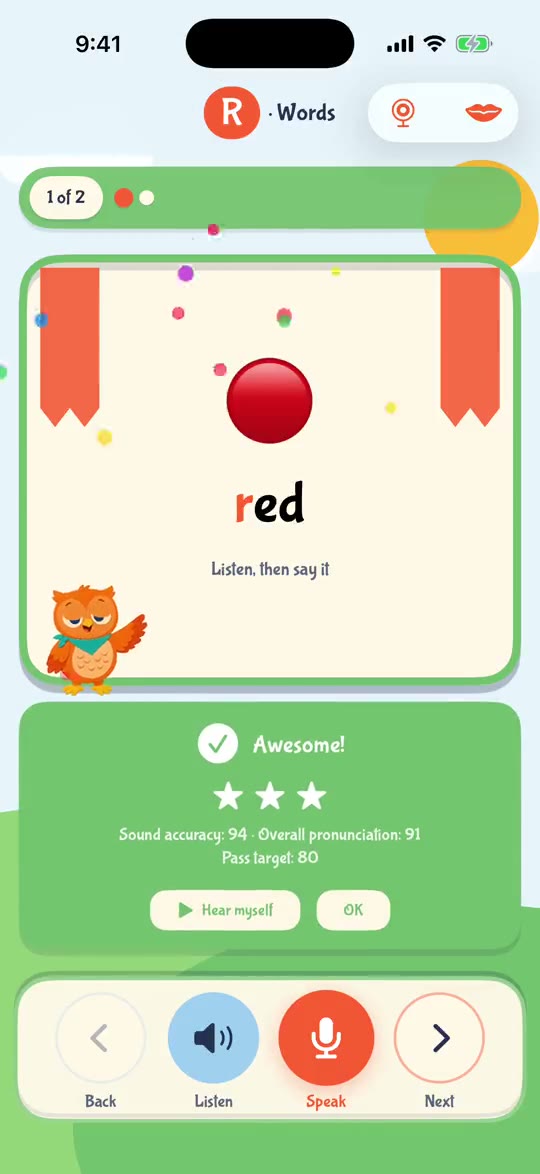
It suits children who talk and want clearer sounds. There are 30 sound lessons. Your child says a word out loud, and the app scores the attempt. The score needs an internet connection. The app also has Make Sentence, a picture board with 897 pictures, for children who are starting to join words. It can use your own photos, and it reads the sentence out loud.
It works on iPhone, iPad and Android, in English only. You can try the whole app free for 3 days, then it is $9.99 a month or $49.99 a year in the US.
Inside the app
See a practice session, step by step
This is the R sound in Help Me Talk. Your child says the word, the app scores the attempt and asks for another try when the sound slips.
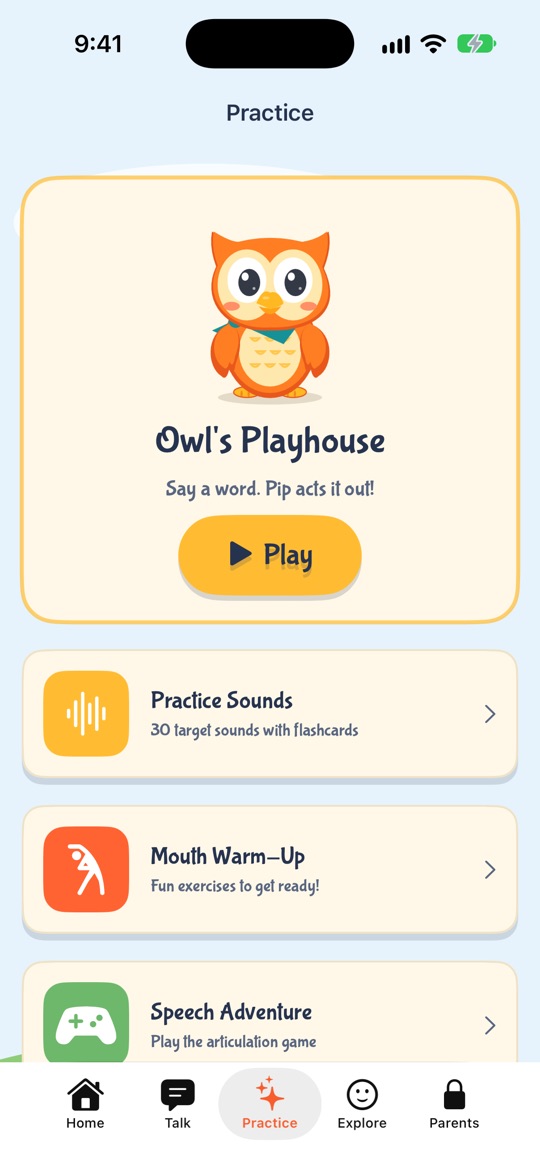
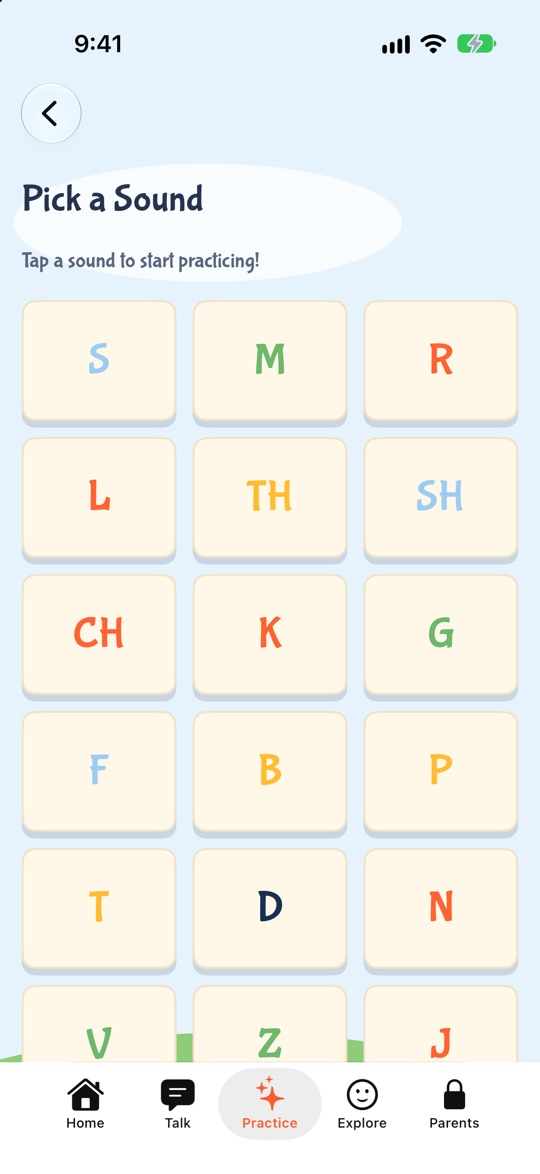
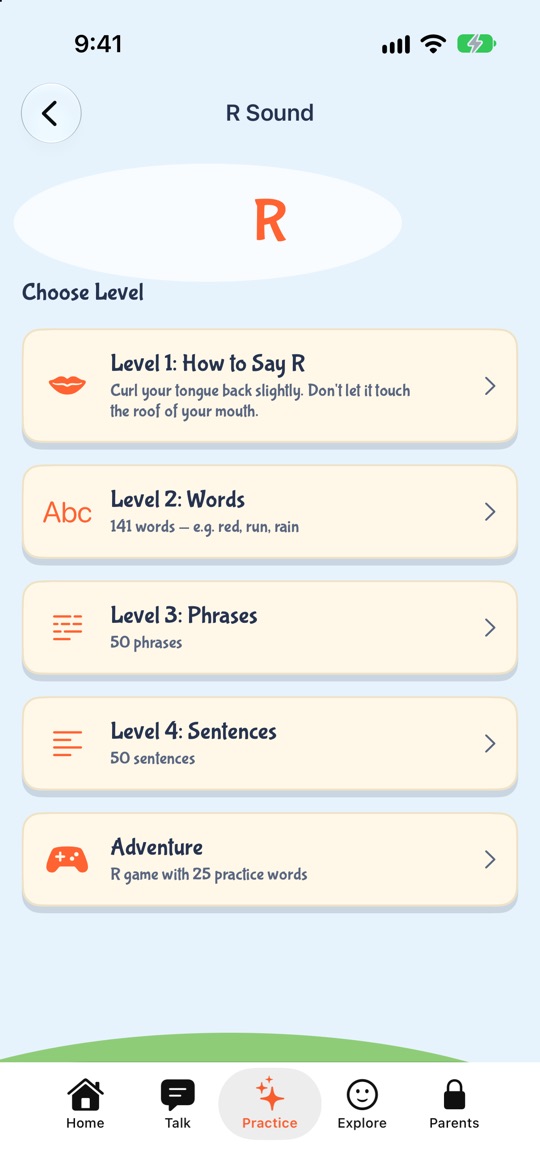
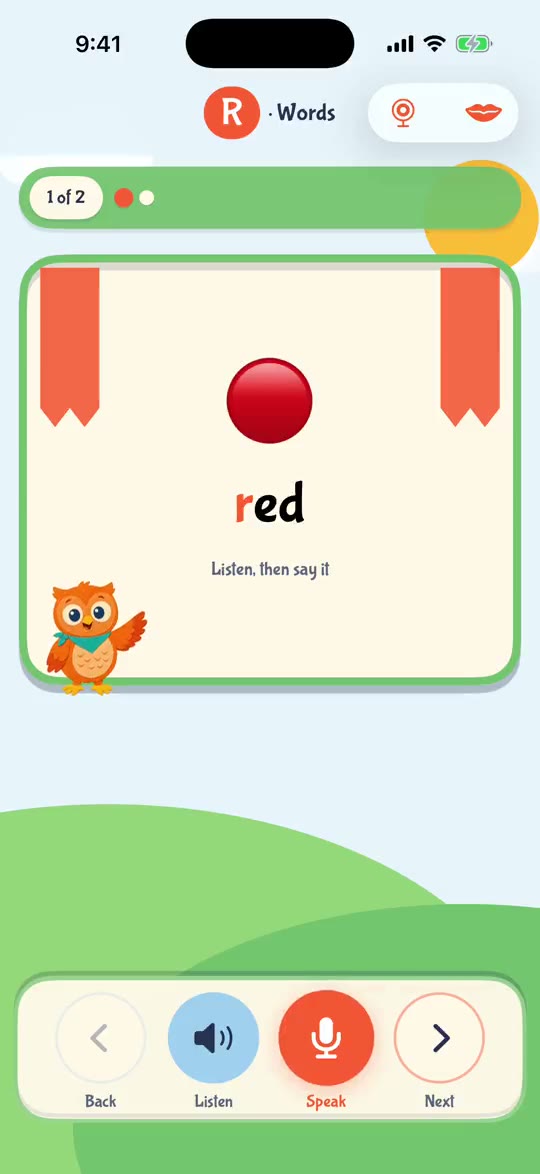
1. Open Practice Sounds
30 target sounds, each with words, phrases and sentences.
Try it with your child. Free to download.
When to ask for help
An app does not tell you what is causing your child's speech difficulty, and neither does this guide. Talk to your doctor or a speech-language pathologist if your child has few words for their age, loses words they used to say, gets very upset because they cannot be understood, or if you are simply worried. You do not need to be sure before you ask.
Help Me Talk is a practice app, not a diagnosis or a replacement for a licensed speech-language pathologist. If you are worried about your child’s speech, talk to your doctor or an SLP. This app is for the practice in between.
Questions parents ask
- What is a picture talker?
- A picture talker is an app or device where a child taps pictures and it speaks the words out loud. It is a type of AAC, which means augmentative and alternative communication. It gives a child a way to communicate when speech is not enough.
- What is the difference between an AAC app and a speech therapy app?
- With an AAC app, the device speaks for your child. With a speech practice app, your child does the speaking and works on making sounds clearer. AAC gives a child a voice now. Speech practice improves the voice they already use.
- Does AAC stop a child from learning to talk?
- No. Research finds that AAC does not hold back speech and often supports it. Your child hears the word each time they tap a picture, and learns that communicating works.
- What age can a child start using a picture talker?
- There is no set age. A child does not need to reach a certain age or skill first. A speech-language pathologist can help you decide if it fits your child now.
- What age is right for a speech practice app?
- Usually from around age 3, once a child can try a sound when asked. Younger children and children with very few words often get more from play and daily talk at home.
- Can my child use both?
- Yes. Many children use a picture talker through the day and practise sounds for a few minutes when they are ready. Keep the picture talker available all the time, and keep practice short.
- Is Help Me Talk an AAC app?
- No. Help Me Talk is a speech practice app with a picture board for building short sentences. A child with no reliable way to speak usually needs a full AAC system chosen with a speech-language pathologist.
Keep reading
- Speech apps for autistic children
- AAC apps compared
- Make Sentence: the picture board in Help Me Talk
- How to help my child speak in sentences
- Can a speech app tell if your child got it right?
- The 18-month speech checklist
- The 2-year-old speech checklist for your child
- The 3-year-old speech checklist for your child
Last updated 31 October 2026.