Guide
Speech practice in 5 minutes a day
Five minutes a day is enough to move a speech sound forward, as long as it happens most days and the minutes are spent on saying the sound. This guide gives you the five minutes, one minute at a time. It shows where to put them in a busy day, what to practise once your child gets better, and what to do when it stops working. It is for parents of children aged about 3 to 9 who are working on one or two sounds, with or without a speech therapist.
The short answer
Pick one sound. Tie the practice to one fixed moment in the day, like after breakfast or before the bath. Spend one minute warming up with the sound alone, three minutes on 10 to 15 words or phrases at your child's current level, and one minute on a quick game or a sentence. Aim for 20 to 30 tries in the five minutes. Stop on time, even when it is going well. Count the clear tries, and move up a level when your child gets about 8 out of 10 right for a few days.
US prices for iOS and Android. Prices vary by country; your store shows the price before you subscribe. The new prices are active on Google Play and take effect on the App Store on October 8, 2026.
Why five minutes is enough
A speech sound is a movement habit. The tongue, lips and breath have to land in the same place hundreds of times before the new way becomes the easy way. Habits grow from many short repeats, not from one long effort. Five focused minutes with 25 tries, done six days a week, is 150 tries a week. A 40-minute weekend session with a tired child rarely gets close to that.
Short also means it survives. The main reason home practice stops is not that parents give up. It is that the session was too big to fit on a normal Tuesday. Five minutes fits on a normal Tuesday.
The catch is that the minutes have to be spent on the sound. Five minutes of looking for the flashcards, or of a child blowing bubbles, is not five minutes of practice. The plan below keeps the whole time on saying words.
The five minutes, minute by minute
Keep the same shape every day. Your child learns what comes next, which saves time and arguing. You can run the whole thing with a list of words on your phone and nothing else.
| Minute | What you do | Why it is there |
|---|---|---|
| 1 | Say the sound alone 5 times together. Show the mouth shape. Then 5 easy words your child already says well. | Wakes up the movement and starts with a win. |
| 2 to 4 | Work through 10 to 15 words or phrases at today's level. You say one, your child says it back. Give a quick yes or try again. | This is the real practice. Most of the tries happen here. |
| 5 | One quick game turn, or one sentence with two target words, or read one page of a book and catch the sound. | Ends on something fun so tomorrow is easy to start. |
| After | Say one thing your child did well. Note how many tries were clear. Put the list away. | Keeps the habit and gives you a number to watch. |
Where the five minutes go in the day
A practice slot that depends on remembering will fade in two weeks. A slot that is tied to something that already happens every day will last. Pick one anchor and keep it for at least a month before you change it.
| Anchor | Works well for | Watch out for |
|---|---|---|
| After breakfast, before shoes | Children who are fresh in the morning | School-day rush. Keep the word list by the door. |
| In the car on the school run | Families with a daily drive | You cannot see the mouth. Good for words, not for a new sound. |
| Straight after school, with a snack | Children who need to unwind by talking | Some children are too tired. Try after the snack, not during. |
| Before the bath | Evening routines that already run the same way | If bath time is a fight, do not add practice to it. |
| Before the bedtime story | Calm children, calm houses | Late means short. Two minutes is still fine. |
What to practise at each level
Speech sounds are learned on a ladder: the sound alone, then in words, then in short phrases, then in sentences, then in talking. Five minutes a day works at every step. What changes is what you put in minutes two to four.
Move up when your child gets about 8 out of 10 right on three different days. Move down one step if a new level gives fewer than 5 out of 10 for a week. Going down is not failure. It is how you find the right amount of challenge.
| Level | The 5-minute version | Move up when |
|---|---|---|
| Sound alone | Mirror, 20 tries of the sound by itself. Add an easy vowel after it, like "see" or "so". | The sound comes out clearly most of the time |
| Words | 10 to 15 words with the sound at the start. Then at the end. Then in the middle. | 8 of 10 words clear, three days running |
| Phrases | Two-word phrases, like "big sun" or "my sock". 10 to 15 of them. | 8 of 10 phrases clear |
| Sentences | 5 to 8 short sentences with one target word each. Your child repeats, then makes one up. | 8 of 10 sentences clear |
| Talking | Read a page together, or describe a picture. Count the target words that come out clear. | Clear in normal talk most of the time |
One sound at a time
Five minutes is not long enough for two sounds. Pick the one that bothers you most, or the one your speech therapist named. Stay on it until it is clear in sentences before you start the next.
If you are not sure where to start, the sounds most children learn earliest are P, B, M, D, N and H. Sounds like S, L, SH, CH, R and TH come later and often need the most practice. Our age checklists show which sounds are expected by age 4 and age 5.
- Pick the sound that is easiest to see. P, B and M are visible on the lips. A child can copy what they can see.
- Do not start with R. It is the hardest sound to practise at home. If R is the only problem, read how to teach the R sound first.
- Let a therapist choose if you have one. They know which sound will give your child the biggest change.
The first two weeks
The first week is about building the habit, not about the sound. If the five minutes happen six days in a row, week one is a success even if the sound is the same as before.
| Week 1 | Week 2 | |
|---|---|---|
| Goal | The slot happens every day | Tries go up to 25 or more |
| Minutes 2 to 4 | The same 10 easy words each day | Swap in 5 new words every other day |
| What you count | Days done | Clear tries out of 10 |
| What you say | "We did it again" | "That S was really clear" |
| Expect | Little change in the sound | The sound clear in a few words |
How to know it is working
You cannot judge progress by ear from one day to the next. Some days the sound is clear, some days it is gone, and both can happen in the same week. Two simple checks work better.
First, count. After each session, write down how many tries out of 10 were clear at the current level. Look at the numbers once a week, not once a day. A level that was 4 out of 10 and is now 7 out of 10 is real progress, even if your child still sounds the same to a grandparent.
Second, record. On the same day each week, record 30 seconds of your child talking about anything. After a month, play the first one and the last one back to back. The change is often clear in a way it never is day to day.
Problems and fixes
| What happens | Try this |
|---|---|
| Your child refuses to start | Make it two minutes for a week. Start with five words they already say well. |
| Your child says the words but rushes them | Slow it down with a turn-taking game. One word, one turn. |
| The sound is clear in practice and gone the rest of the day | Normal. It comes last to talking. Catch one real word a day and praise it. |
| You keep forgetting | The anchor is wrong. Move the slot to a moment that never gets skipped. |
| Your child gets upset at try again | Say the word yourself and move on. Three clear tries beat ten upset ones. |
| You run out of words | Every sound page on this site has word lists at each level. Open one on your phone. |
| Five minutes turns into fifteen | Set a timer. Stopping on time is what makes tomorrow easy. |
| Nothing changes after six weeks | Check the level. If the sound alone is still unclear, ask a speech therapist to check how your child makes it. |
Doing it with Help Me Talk
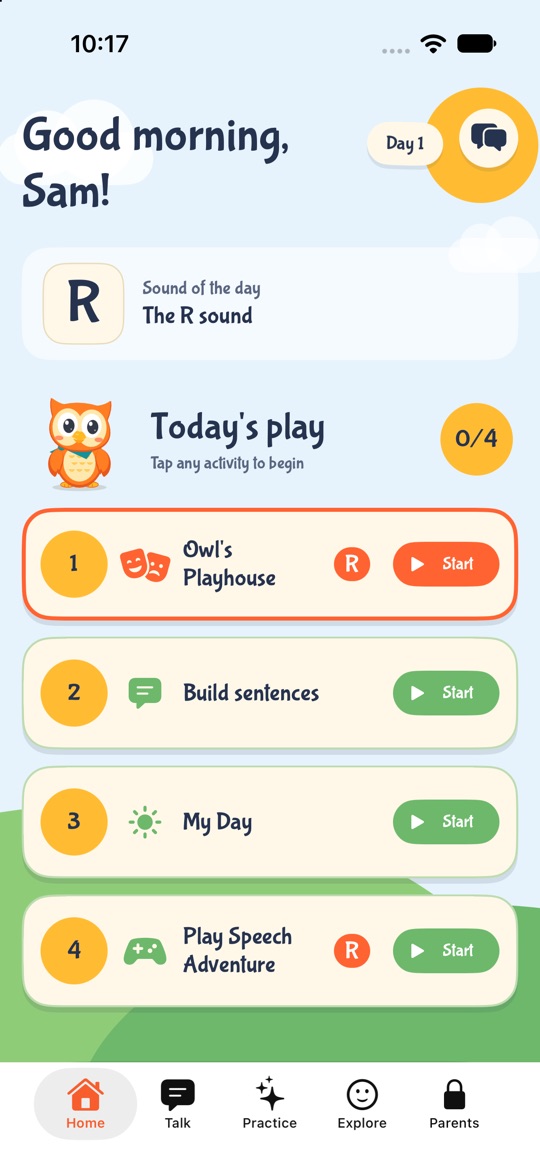
Our app runs the same shape of session, with the counting done for you. In the setup you say how many minutes a day you have. The choices are 5, 10, 15 or 30. The app then builds a 4-week plan with one sound a day, starting with the sounds you mark as hard.
On a 5-minute setting each sound activity runs about two minutes, and a full day of four cards is about seven minutes. You do not have to do all four. Two cards on a busy day is fine, and the plan carries on. In Practice Sounds, your child says the word, the app listens and scores the try, and asks for another go when the sound slips. The app covers 30 English sounds and over 3,000 words.
On iPhone and iPad you can set a reminder time in Settings, and a gentle reminder arrives if a few days pass with no practice. The app is English only and works on iPhone, iPad and Android. The whole app is free for 3 days, then it is $9.99 a month or $49.99 a year in the US.
Inside the app
See how the plan is made
These are the real setup screens in Help Me Talk. You answer five short questions and the app builds a 4-week plan, one sound a day.
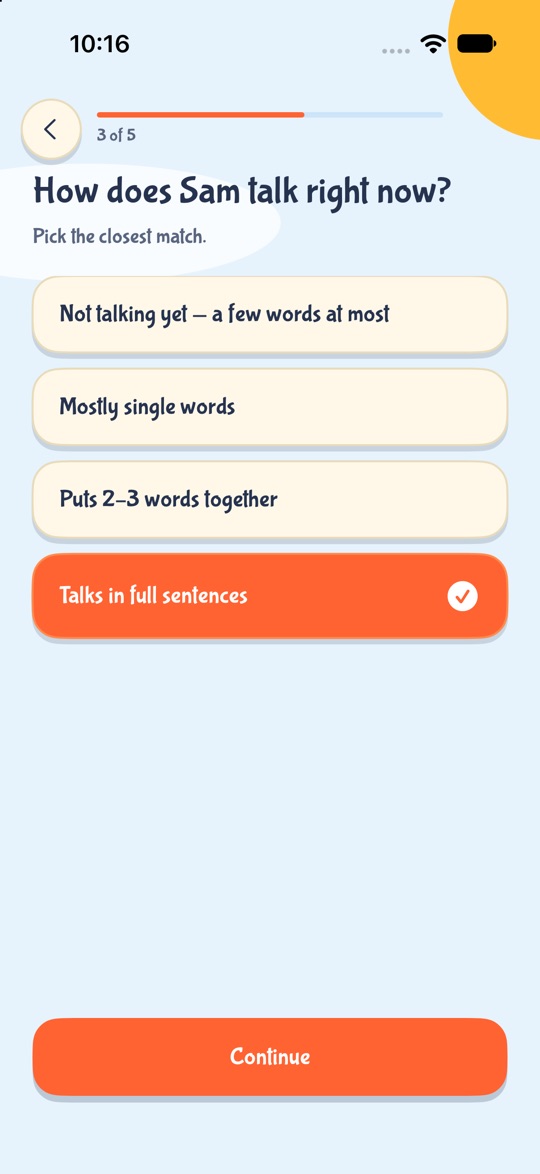
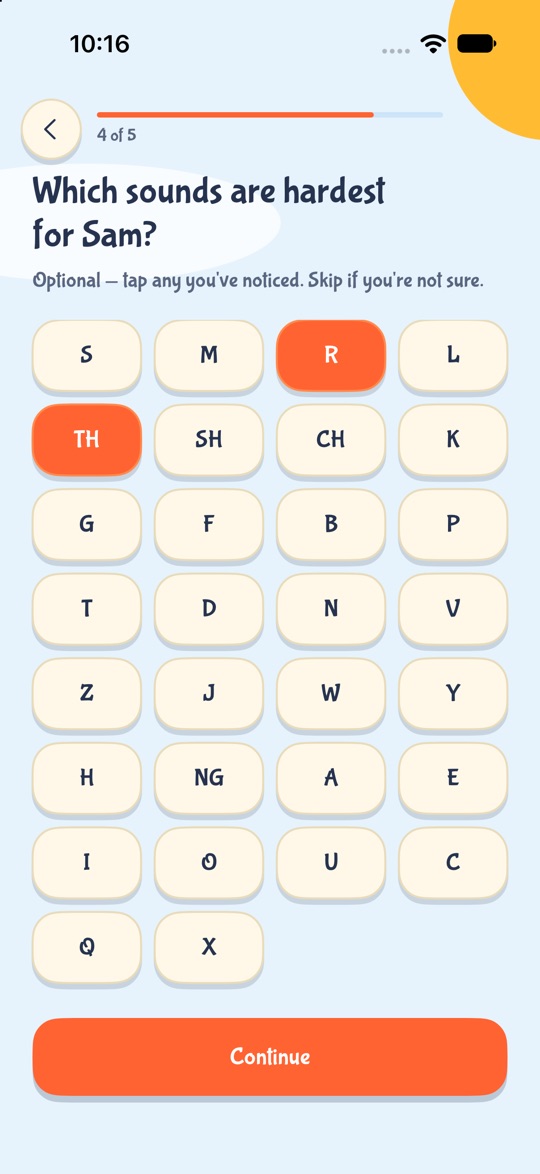
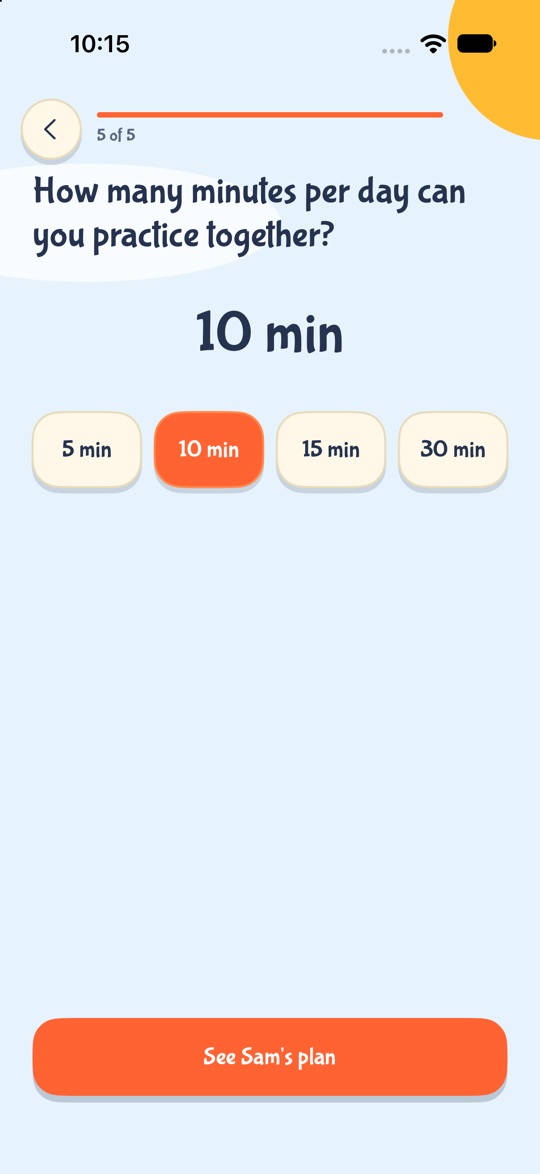
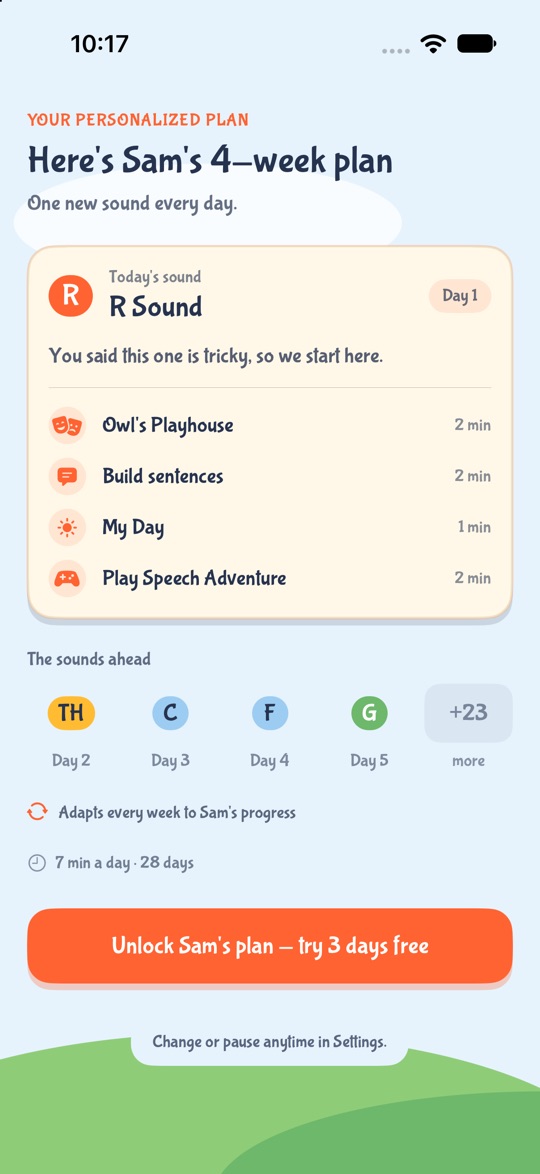
1. Say how your child talks
Name, age, then how they talk today. Pick the closest match.
Try it with your child. Free to download.
When five minutes is not enough
Five minutes a day is practice. It is not an assessment and it is not therapy. See a speech-language pathologist if any of these are true.
Many families do both. The therapist picks the sound and shows the mouth position. The five minutes at home give that sound the repeats it needs between sessions.
- Your child is 3 and strangers understand less than half of what they say.
- Your child is 4 and people outside the family often ask you to translate.
- Your child cannot make the sound alone, even after a month of trying the mouth position.
- Your child leaves out sounds or whole parts of words, not just one sound.
- Your child gets frustrated or stops talking because of being misunderstood.
- Your child is losing words or sounds they used to have.
Help Me Talk is a practice app, not a diagnosis or a replacement for a licensed speech-language pathologist. If you are worried about your child’s speech, talk to your doctor or an SLP. This app is for the practice in between.
Questions parents ask
- Is 5 minutes a day really enough for speech practice?
- Yes, for one sound, when it happens most days and the time is spent on saying words. Five minutes with 20 to 30 tries, six days a week, gives more useful practice than one long session at the weekend.
- How many words should my child say in 5 minutes?
- Aim for 20 to 30 tries in total. That is 5 easy warm-up words, 10 to 15 words or phrases at the current level, and a few more in the game or sentence at the end.
- What is the best time of day for speech practice?
- The time that already happens every day. After breakfast, in the car, after school with a snack, or before the bath all work. The best time is the one you will not skip.
- Should I correct my child when the sound is wrong?
- Say the word correctly yourself and ask for one more try. Do not explain what went wrong. Hearing the right version is what helps. Keep the mood light and stop on time.
- How long until I hear a difference?
- Most families see the sound clear in single words within 2 to 4 weeks of daily practice. Clear in everyday talking takes longer, often a few months. Count clear tries each week instead of listening for a change each day.
- Can I practise two sounds in one 5-minute session?
- No. Five minutes is enough for one sound. Finish one sound to the sentence level before you start the next. If a therapist gave you two sounds, do them on alternate days.
- Does Help Me Talk have a 5-minute setting?
- Yes. In the setup you choose 5, 10, 15 or 30 minutes a day. On 5 minutes each activity is about two minutes, and you can stop after one or two cards. The app scores each try, so the counting is done for you.
Keep reading
- Speech therapy at home: a weekly plan
- The 4-week practice plan in Help Me Talk
- Speech therapy exercises for kids
- Speech games for 5-year-olds
- How the app tracks progress
- How to teach the R sound
- The 18-month speech checklist
- The 2-year-old speech checklist for your child
Last updated 1 November 2026.